
Backing the Right Longshot
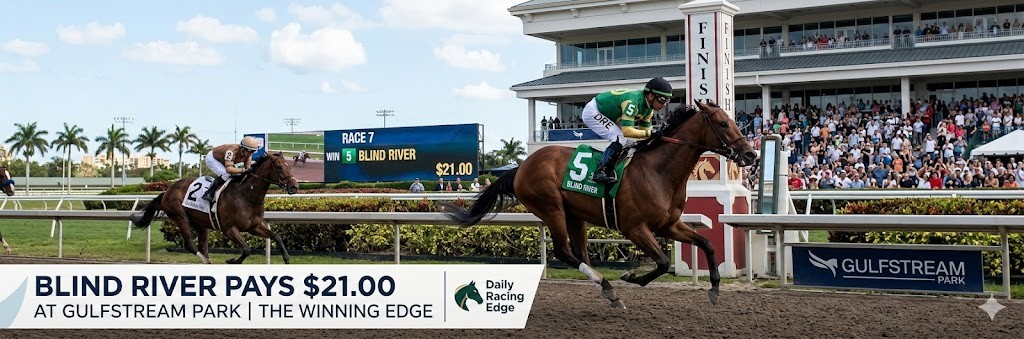
The 8/1 “Gift”: Why Class Always Trumps the Calendar
We’ve all seen it: a horse you know is the best athlete in the field starts climbing in odds, from 3/1 to 5/1, and finally hits a juicy 8/1 just as the gates open. In your gut, you know the crowd is wrong, but the “smart money” seems to be running away from your pick.
On February 27th, 2026, that gift was a 3-year-old gelding named 9 Blind River. While the public was spooked by a 195-day layoff, professional bettors saw a “launchpad”. Here is how you can use original insight and authoritative data to spot the next mispriced longshot.Final Contender Ranking and Analysis (Race 5, February 27, 2026)
The Setup: The “195-Day” Scare
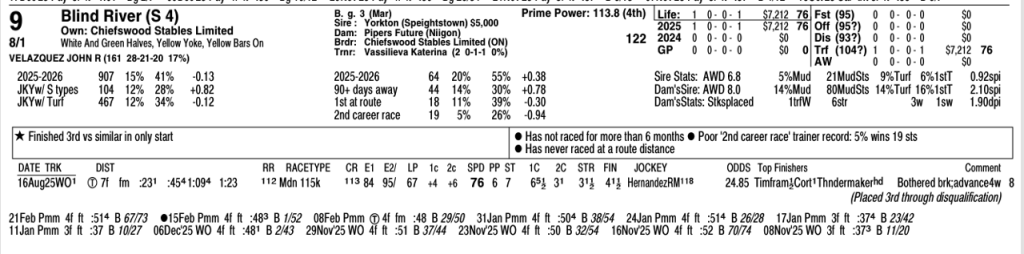
The typical bettor sees a 6-month gap on a young horse and assumes injury, poor form, or a “prep” effort. Blind River hadn’t raced since August 16th at Woodbine. But look at where he spent those 195 days: Palm Meadows (PMM).
Palm Meadows is arguably the best training facility in North America. When a horse has a steady, unbroken string of workouts there since November, they aren’t “recovering”—they are training for a specific target.
The Authoritative “Tell”: On February 15th, Blind River fired a “Bullet” workout—4 furlongs in :48.65, ranking 1st out of 52 horses. If a horse is slow or unfit, they don’t outwork 51 other athletes. That single “1/52” stat was a neon sign that the layoff was a non-issue.
The Original Insight: Class Overrides the Calendar
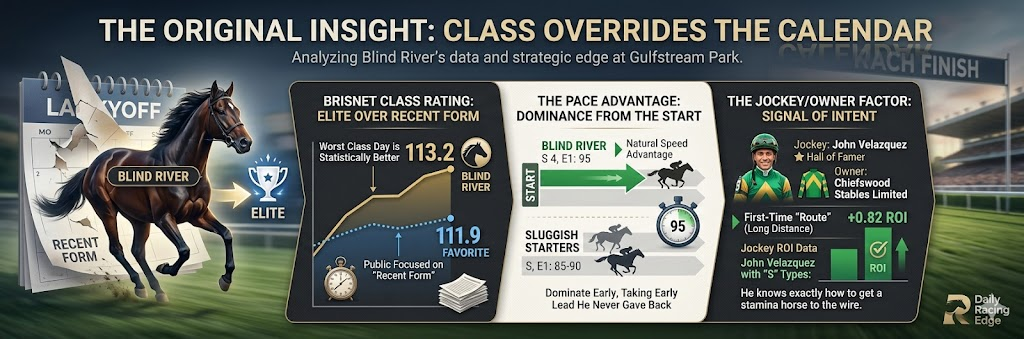
If you looked past the layoff, the data screamed “elite.” The public was focused on “recent form,” but the data was focused on established “class.”
Brisnet Class Rating: Blind River held a field-high 113.2 (versus the favorite’s 111.9). This means that his worst “class” day was still statistically better than any of the favorites’ “best” days.
- The Pace Advantage: While labeled a “Closer” (S 4), Blind River actually possessed the highest Early Pace (E1) ranking (95) in a field full of sluggish starters. This natural speed advantage meant he didn’t need a “fast pace” trip; he could just dominate them early, which is exactly what he did, taking an early lead he never gave back.
- The Jockey/Owner Factor: Hiring Hall of Famer John Velazquez for a first-time “Route” (long distance) was the ultimate signal of intent from the owners, Chiefswood Stables Limited. We know Johnny V holds a +0.82 ROI when piloting “S” type horses—he knows exactly how to get a stamina horse to the wire.
The Payoff: Why This Matters to Your Wallet
Because the public chased “hyped” debutants like 1 Wrathchild (who faded to 7th), Blind River was entirely overlooked.
The result?
- A $21.00 Win Payout on a horse that, statistically, should have been the 2/1 favorite.
- A $51.00 Daily Double (3-9) for those who coupled him with another high-class horse in the early races.
The crowd played “scared” and lost. The professional bettors who trusted the PMM works, the Class Rating, and the Velazquez/Chiefswood connection got paid 8-to-1 on a mathematically superior horse.
Handicapper’s Takeaway for Future Bets:
- The Owner-Breeder “Information Gap”: When the owner and breeder are the same (like Chiefswood), they possess multi-generational data on the horse’s family. They aren’t guessing if he can handle the distance or surface—they built him for it. A major homebred shipping to Florida with an elite jockey is always a powerful signal of intent.
- Spotting the “Hidden” Class Drop: On paper, it was a Maiden Special Weight to another. In reality, Blind River was dropping from a $115,000 purse at Woodbine to an $84,000 purse at Gulfstream. This is a significant drop in the quality of the competition, which was reflected in his field-high 113.2 Class Rating.
- The “Shipper” (Surface) Change: Pay close attention to horses shipping from Woodbine’s lush turf or synthetic tapeta to the firm, fast, “tight-turn” turf at Gulfstream. Speed-heavy horses (like Blind River with his 95 E1 rating) often find their speed carries much further on the Florida grass.
- The “Bullet” is King: A horse with a “1/XX” workout rank at a major facility (PMM, Paynter, Santa Anita) is almost never “unfit,” regardless of the layoff length. The class wasn’t gone; it was just hidden.
Finish Position | Race Comment and Fact
1. Blind River (#9) – The ultimate value play. The public feared the 195-day layoff, but his 1/52 “Bullet” work at Palm Meadows (PMM) proved he was peaking. As a Chiefswood Homebred with a Velazquez jockey upgrade, this was a clear signal of intent for an $84k purse. He won handily gate-to-wire, validating his dominant pre-race class numbers.
- Rank: 1
- Finish Pos: 1st
- Final Odds: $9.50 (8/1+)
- Brisnet Class Rating: 113.2 (Field High)
- Jockey: J. R. Velazquez
- Owner: Chiefswood Stables Limited
2. Lemon’s Law (#3) – Ran a brave race as the public’s choice. While highly logical and in strong current form, he was ultimately beaten by a horse that possessed statistically superior established class. He is a strong, consistent factor in this division but was outmatched by a “A-level” talent.
- Rank: 2 –
- Finish Pos: 2nd
- Final Odds: $3.80 (Favorite)
- Brisnet Class Rating: 111.9
- Jockey: J. Alvarado
- Owner: R. A. Hill Stable and SGV Thoroughbreds
3. Gotcha (#7) An honest effort from a horse that has shown consistency. However, he lacked the winning “tell” that separated Blind River from the pack (e.g., the dominant PMM bullet work or the high-percentage Owner-Breeder connection). He remains a solid trifecta filler.
- Rank: 3
- Finish Pos: 3rd
- Final Odds: $6.00
- Brisnet Class Rating: 111.5
- Jockey: T. Gaffalione
- Owner: M. Dubb et al.
4. Easy Pick (#10) – Had the highest Late Pace rating (91) last race, pointing to a standard “closer” trip. He was far outpaced early by the dominant winner and could only pass tired horses in the stretch. He was strictly outclassed by the top three finishers.
- Rank: 4
- Finish Pos: 4th
- Final Odds: $20.20
- Brisnet Class Rating: 110.5
- Jockey: E. J. Zayas
- Owner: G. Barber
5. Vol Du Condor (#8) A massive longshot on the board, and he performed strictly to his data limitations. He showed early foot but could not keep up with the winner’s blistering :48.0 flat half-mile and was logicially outrun.
- Rank: 5
- Finish Pos: 5th
- Final Odds: $56.60
- Brisnet Class Rating: 110.2
- Jockey: L. Reyes
- Owner: E. L. Safley
6. Bootsontheground (#2) A useful horse, but he appeared to be strictly pace-compromised and class-challenged. He was unable to handle the required step-up in both speed and quality that this high-level Maiden race demanded.
- Rank: 6
- Finish Pos: 6th
- Final Odds: $12.00
- Brisnet Class Rating: 110.3
- Jockey: P. Lopez
- Owner: E. S. C. Racing Stable
7. Wrathchild (#1) The “Hype” horse of the race. The public over-bet this debutant primarily because he was owned by a major stable (E Five) and ridden by the circuit’s top jockey (Ortiz Jr.). The result proved that established, high-level class (Blind River) usually trumps unproven hype.
- Rank: 7
- Finish Pos: 7th
- Final Odds: $3.90 (2nd Fav)
- Brisnet Class Rating: N/A (Debut)
- Jockey: Irad Ortiz Jr.
- Owner: E Five Racing Thoroughbreds
8. Munny Problem (#5) Another high-profile, first-time starter from elite connections (Oxley and Castellano). He broke evenly but was flat throughout, unable to muster any significant challenge. This effort reinforces the rule that layoffs with established class are often better bets than unproven speed.
- Rank: 8
- Finish Pos: 8th
- Final Odds: $10.40
- Brisnet Class Rating: N/A (Debut)
- Jockey: J. Castellano
- Owner: J. C. Oxley
9. Ruler of the Skies (#4) A Mike Maker veteran angle that did not produce a positive result. He appeared completely listless after the half-mile pole and will need a significant drop in class to compete against these kinds of high-quality maidens.
- Rank: 9
- Finish Pos: 9th
- Final Odds: $22.40
- Brisnet Class Rating: 110.3
- Jockey: J. Ruiz
- Owner: M. J. Maker
10. Manawa (#6) A complete non-factor. He broke slowly, showed no early initiative, and ran evenly toward the back of the pack, outclassed by every other runner in the field.
- Rank: 10
- Finish Pos: 10th (Last)
- Final Odds: $48.00
- Brisnet Class Rating: N/A (Debut)
- Jockey: L. Panici
- Owner: J. F. Orseno
The next time you see a talented horse coming off a long layoff with great connections and a “bullet” work, don’t follow the scared money. Trust the class. Happy hunting.
Bob Shirilla
Audio Analysis: The Data Behind Blind River’s $21 Payout
If you want to go deeper on the Blind River analysis, the audio breakdown below walks through the behavioral economics behind the public’s mistake — why a 195-day layoff triggers cognitive bias, how the Brisnet class gap compounds across a season, and what the Velazquez hire actually signals to a professional bettor. The transcript is below for those who prefer to read:
Welcome to this custom tailored deep dive. We’ve got a really fascinating session lined up for you today, and we are just jumping right into the deep end here.
Yeah, we really are. It’s a great topic today.
It is. So our source material is this incredibly insightful article from March 4th, 2026.
Right, written by Bob Shirilla.
Exactly, for Racing Edge Daily Picks. And the title is, What Blind River’s $21 payout taught me about backing the right long shot.
And while the backdrop of this piece is horse racing, specifically race 5 on February 27th, 2026, the actual mission of our discussion today goes way, way beyond the track.
That’s the key right there. I mean, this isn’t just about picking a winning horse, right?
No, not at all.
It’s a masterclass in behavioral economics. It’s about data analysis, cognitive bias, and most importantly, it’s a guide on how you can spot massive, hidden value right when the rest of the crowd is panicking.
Yeah, our goal today is to extract the absolute best actionable insights from this specific race. We are going to look closely at how authoritative data can and really should confidently override those superficial scare metrics that constantly mislead the general public.
Okay, let’s unpack this. Let’s set the stage and introduce the protagonist of our story today.
Number 9, Blind River.
Yes, a three-year-old gelding named Blind River. He’s wearing the #9 saddle cloth. Now on race day, this horse is sitting at 8 to 1 odds. The crowd is basically running away from him.
Running for the hills.
All right. And the reason they are running away is what the article calls the scare. Blind River hadn’t run a race in 195 days.
Which is a long time.
It is. His last start was way back on August 16th up at Woodbine. Now, I have to play devil’s advocate here for a second. A 195 day gap is over six months. If I’m evaluating an athlete who hasn’t competed in half a year, I’m going to be nervous. Isn’t it completely reasonable for the public to be skeptical?
Well, it’s a completely natural reaction. And that psychological trap is exactly why the market becomes inefficient in the 1st place.
Because we just hate uncertainty.
Exactly. People rely heavily on recent form because it’s visually accessible. It’s easy to just pull up a chart and see what happened last week or, you know, last month. The human brain naturally gravitates toward the most readily available information. So when there’s 195 day blank space, the crowd fills that void with anxiety.
They just assume the absolute worst.
Yeah, they assume injury, terrible form, or that this is just a lazy prep race to shake off the rust.
Right, they see the blank space on the calendar and their imagination just runs wild with negative assumptions.
But professional bettors, the ones who actually make a living finding value, they don’t just accept the blank space. They ask what was happening during that gap.
Which is the billion dollar question.
Right. What’s fascinating here is how Blind River actually spent those 195 days. He wasn’t sitting in a stall recovering from some mysterious ailment.
He was working.
He was at Palmettos, frequently abbreviated as PMM in the data. And for context, Palm Meadows is arguably the finest, most elite training facility in North America.
It’s top tier.
And the data showed that he had been executing a steady, unbroken string of workouts there since November.
See, that completely changes the narrative. Think about it like an NBA star who goes off the radar during the off season.
Yeah, that’s a good way to look at it.
They aren’t playing in any summer pro-am leagues where the public or the media can see them. So the casual fans think, oh, he’s out of shape. He’s just sitting on the couch.
Right, because they can’t see him on Instagram.
Exactly. But in reality, that athlete is locked away in a private, state-of-the-art training camp. quietly grinding with the best coaches in the world, building an absolute monster of a foundation. That’s what Blind River was doing at Palmettos.
That is a perfect analogy. He wasn’t recovering. He was actively training for a highly specific target. And the data proves that this wasn’t just light jogging, which brings us to the most crucial piece of evidence in the source material.
The tell. This is the specific, undeniable data point from the article that signaled to anyone paying attention that Blind River was absolutely ready to explore. load. We’re talking about his February 15th workout.
The bullet workout.
The bullet workout.
Let’s break down those numbers because this is where we shift from speculation to hard mathematical fact. On February 15th, Blind River ran 4 furlongs in 48.65 seconds.
Which is incredibly fast. And for those unfamiliar with the terminology, a furlong is exactly one-eighth of a mile. So 4 furlongs is a half-mile sprint.
Breaking 49 seconds for a half-mile is a serious display of speed. But the raw time isn’t even the most important part of this equation.
It’s the context. It’s that time compared to his peers.
Yes. What matters is that this specific time ranked first out of 52 horses working out at Palm Meadows that time.
Number one out of 52 elite athletes.
The logic here is bulletproof. A horse simply does not accidentally outwork 51 other highly trained thoroughbreds if they are unfit, slow, or recovering from an injury.
You don’t just stumble into being the fastest guy in the gym.
Yep, exactly. You don’t accidentally become the fastest horse at the best facility in North America on a given morning. That one out of 52 stat was a glaring neon sign indicating that the 195 day layoff the public was so terrified of was entirely irrelevant.
The baseline fitness was absolutely there.
It was proven.
If you’re listening to this and looking for that shortcut to being thoroughly well informed, this is it right here. Finding that one authoritative tell cuts through the noise of an entire field of messy data.
It really does.
You don’t need to stress over a six-month gap on a calendar if you have a rock-solid, verifiable piece of data saying, actually, he’s the fastest guy out there right now.
It is the ultimate signal emits the noise. The amateur crowd let the calendar dictate their decision, but the professionals let the current training data guide theirs.
Here’s where it gets really interesting, because the source material brings up this core argument of established class versus
Yes.
And to really understand why the professionals pounded the table for Blind River, we need to talk about the Brisnet class rating.
The Brisnet class rating is a proprietary metric used to quantify the overall quality of competition a horse has proven it can handle. It calculates the par speed and class of the horses they’ve been running against.
And here’s where the data just screams at you. Blind River went into this race with a field high class rating of 113.2.
Which is huge.
It is. But I want to pause here because to a layman, a number like 113.2 doesn’t mean much on its own. And the article mentions that the betting favorite in the race had a best rating of 111.9.
Right.
On the surface, a 1.3 difference sounds microscopic. It sounds like a rounding error. Why is that gap significant?
To understand the significance, you have to look at the scale. These class ratings are tightly clustered. A typical average racehorse might sit in the 80s or 90s. The absolute elite world-class horses push into the upper 110s and low 120s.
Okay, that paints a picture.
So when you are competing at this specific tier, a 1.3 point difference This is massive. It’s a statistical chasm. Mathematically speaking, Blind River’s worst class day on the track was statistically superior to the favorite’s very best day.
It’s like comparing baseball players. A guy batting .30 and a guy batting .280 might look incredibly similar in a single game. It’s just a fraction of a difference.
Yeah, it’s barely noticeable.
Right. But over the course of a season, that gap represents the difference between an All-Star and a guy sitting on the bench. Blind River’s floor was higher than the favorite ceiling. And yet, he’s sitting there at 8 to 1 odds.
And the auto points out another brilliant angle that the public completely missed. The hidden class drop.
Yes. On paper, if you’re just glancing at the race program, it looks like a lateral move. Blind River was running in a maiden special weight race. and he was entering another Maiden special weight race.
And we should clarify that Maiden in horse racing means a horse that has literally never won a race. So these are all unproven horses.
Because the category looked the same, the crowd assumed he was facing the exact same level of competition.
But the money tells the real story. In Maiden races, because none of the horses have a track record of winning, the plus size, the amount of prize money up for grabs is the only true indicator of the competition level.
Follow the money.
Always. The article notes that Blind River was dropping from a race with a $115,000 purse at Woodbine down to an $84,000 purse at Gulf Stream.
That is a massive DC.
It changes the entire complexion of the race. A $115,000 race attracts a much tougher, more expensive group of unproven horses than an $84,000 race.
Makes sense.
So even though the category of the race looked identical on the program, Blind River was experiencing a massive drop in the quality of his competition. He was an A-level talent who was suddenly swimming in a significantly smaller pond.
And the crowd completely missed it. They’re agonizing over this 195-day layoff. Totally blind to the fact that he’s taking a massive step down in competition and holds a feel-high class rating of 113.2.
see the forest for the trees?
Exactly. The advantages didn’t stop there. Let’s talk about the tactical advantages, specifically the pace and the surface change.
So on paper, Blind River was categorized as an S4 type. The S stands for sustained, which in racing terminology means a horse that typically hangs back early and tries to pass everyone with a sustained run at the end.
And the four.
The 4 usually indicates their specific energy distribution profile, generally suggesting a late running style. So the public looks at that label and assumes he’s going to be at the back of the pack.
But the underlying data told a completely different story.
This raises an important question. What happens when a horse’s label contradicts their actual metrics? Because despite being labeled a closer, Blind River possessed the highest early pace ranking in the entire field, an E1 rating of 95.
Wow.
He was incredibly fast out of the gate. And when you combine that hidden early speed with the surface change shipper angle, it becomes a lethal combination.
Let’s talk about that surface change, because the environmental shift from Woodbine to Gulf Stream is fascinating.
Blind River was shipping from Woodbine in Canada, which features a synthetic tapetta surface and a very specific type of lush turf. He was moving down to Gulfstream Park in Florida.
Night and day difference.
Completely. Gulfstream is notorious for its firm, fast turf course with tight turns. It’s basically like running on a pool table compared to a woodbine.
A pool table, that’s a great image.
The source explains that when speed-heavy horses make that specific move onto the firm Florida grass, they face far less resistance. Their early speed carries much, much further.
So you have a horse with the highest early speed metric dropping in moving to a surface that amplifies that early speed. And the result, Blind River took the lead early and never looked back.
A textbook execution.
He won gate to wire, meaning he took the lead at the starting gate and held it all the way to the finish line, laying down a blistering 48.0 flat half mile that simply broke the rest of the field. I mean, look at a horse like Voldu Condor from that same race.
Right, the long shot.
Yeah, he was a massive long shot, showed some early foot, but was logically outrun because he just couldn’t keep up with that blistering pace Blind River set.
The data predicted the exact trip, but we also have to look at the human element, what the author calls the information gap.
This is crucial.
The owner and breeder of Blind River is Chiefswood Stables Limited. Because they are a major homebred operation, they aren’t guessing about what this horse can do. They have multi-generational data on this horse’s pedigree.
They know exactly what they have in the barn.
They literally built and bred this horse for this exact distance.
That information gap between the insiders and the public is a massive edge in any market. And Chiefswood signaled their intent incredibly loudly by hiring John Velasquez to ride the horse.
A true legend.
Velasquez is a Hall of Fame jockey. Putting him on a horse for a first time row, which is a longer distance two-turn race, is the ultimate green light.
The statistics back that up too. The article highlights that Malasquez holds a plus 0.82 return on investment, or ROI, when piloting S-type horses.
That’s incredible.
He is a master at knowing exactly how to conserve a stamina horse’s energy and get them to the wire. So you have elite, highly informed owners pairing up with an elite, highly specialized jockey. Every single piece of authoritative data pointed to a massive performance.
Which brings us to the most baffling part of this entire deep dive. If all this data was available, who is the public actually betting their hard-earned money on?
Oh, this is the best part.
Enter horse #1, Rathchild, who ended up finishing a dismal 7th, and horse #5, Money Problem, who finished 8th. Why on earth was the crowd throwing money at these two while ignoring the mathematical giant in the room?
In a word, height.
Pure hype.
Rathchild was a debutante. That means he had never even run a professional race before. The public threw their money at him purely because he was owned by a major famous stable, E5, and was being ridden by the circuit’s top jockey, E-Rod Ortiz Jr. Brand names. Exactly. Money Problem was in the exact same boat. Another first-time starter with Elite Connections, owned by Oxley and ridden by Castellano. Both of them broke okay from the starting gate, but were totally flat and uncompetitive when the real running started.
It’s unbelievable. Think about how often we see this in the real world. It’s like people throwing their life savings at a tech IPO just because a famous venture capitalist tweeted about it while completely ignoring the boring established blue chip company right next to it that actually has a proven product and incredible financials.
That’s exactly what happened here. The critical lesson is that established class trumps unproven hype every single time. The crowd bet on the finding new objects with the famous names, ignoring the fact that neither horse had ever proven they possessed the baseline class to compete at an $84,000 level.
And then you have the logical favorite, horse #3, Lemon’s Law. The crowd bet him down to $3.80, making him the heavy favorite. Now, to be fair, he actually ran a really brave, consistent race and finished second.
He did run well, but as the article points out, he was just mathematically outmatched. He’s a good horse, but he ran into an A-level talent with superior established class.
Even horses like Gotcha, who finished third, put in an honest effort, but lacked that winning tail like a bullet workout or an elite owner-breeder connection that separated Blind River from the pack.
Right, or easy pick and forth, who actually had a high light pace reading, but was just outclassed and outpaced early by our winner. They were all essentially running for second place from the moment the gates open.
So what does this all mean? We’ve talked about the psychology of the layoff, the mechanics of the class ratings, the pace, and the hype. But let’s talk about the actual financial payoff. for the people who trusted the data over their own fear.
The financial reality is striking. Blind River paid out a massive $21 on a standard $2 win bet. So we are talking about 9.5 to 1 odds.
Amazing.
Based on the statistical data and class ratings we just discussed, the author notes that Blind River should have realistically been the 2 to 1 favorite.
A 2 to 1 favorite. And the market let him float up to nearly 10 to 1. You’re getting an elite, $84,000 level athlete at a massive, massive discount.
And it gets better for those who understand how to leverage these inefficiencies. For bettors who connected him with another high-class horse in the preceding race, The Daily Double payout, which requires you to pick the winner of two consecutive races, paid $51 for the 3-9 combination.
Wow.
When you have a horse that is mathematically mispriced by that much, the compounding payouts and exotic bets like the Daily Double become incredibly lucrative.
If we connect this to the bigger picture.
If we connect this to the bigger picture, it perfectly illustrates the absolute cost of cognitive bias. The public played scared. They let a 195-day layoff on a calendar blind them to the underlying reality of the horse’s fitness.
I just panicked.
They lost their money chasing the unproven hype of debutantes. Meanwhile, the professionals, the ones who stripped away the emotion, trusted the one out of 52 Palm Meadows workout data, respected the Brisnett class rating, and recognized the Velazquez Chiefswood signal of intent they got paid handsomely on a horse that was mathematically superior to the entire field.
It really is a beautiful blueprint for you, whether you are handicapping a race, analyzing a stock market anomaly, or evaluating a business competitor. Look for the information gap where insiders know more than the public. Spot the hidden class drops, look past the superficial labels and follow the actual money like those purse sizes. Respect the environmental changes that might give an entity an invisible advantage. And above all else, remember that the bullet workout is king. Hard, verifiable data of current elite performance will always trump a scary-looking calendar.
That is the core takeaway. When you see a talented entity returning from a long absence, your first instinct shouldn’t be fear. Don’t follow the scared money. Don’t fall for the unproven hype of the shiny new object. Dig into the underlying work and trust the established class. The value is almost always hidden right there in plain sight, waiting for someone willing to look past the superficial metrics.
I couldn’t have said it better myself. We want to thank you so much for joining us on this deep dive into finding hidden value through authoritative data. It’s been an absolute blast unpacking this with you today. But before you go, I want to leave you with a final provocative thought to mull over.
Love this part.
We’ve talked a lot about how human emotions, specifically fear and hype, creates these massive market inefficiencies. But think about the rapid rise of AI and the algorithmic models that process data without any emotion at all. Right. As these predictive models become cheaper and more widespread, will these information gaps eventually vanish entirely? Or is the human instinct to panic at a 195-day layoff so deeply hardwired into our collective psychology that the market will always be just a little bit irrational, leaving the door open for those who know exactly where to look? Keep questioning those assumptions, keep digging deeper, and we’ll catch you on the next session. Take care.