Horse Racing Pace Handicapping: The Complete Guide
The fundamental axiom within the discipline of Thoroughbred handicapping remains that pace makes the race. While the casual observer often fixates on the final time or the visual aesthetic of a horse’s closing kick, the professional analyst recognizes that every race is a complex thermodynamic event where the distribution of energy determines the eventual outcome.
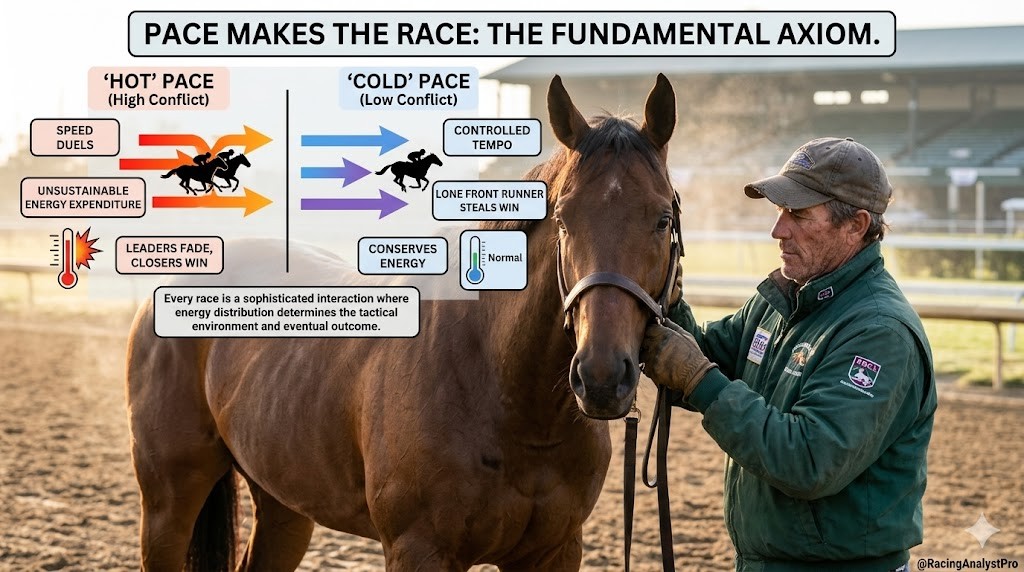
Pace analysis, or “race reading,” is the sophisticated art of predicting how the collective running styles of every horse in a field will interact to create a unique tempo.
This interaction dictates whether a talented runner will be afforded the tactical environment necessary to excel or whether it will be doomed by an unsustainable expenditure of energy in the opening furlongs.
The Physics of Pace: Foundational Concepts for the Modern Analyst
At its most elementary level, pace is the rate at which horses run during specific segments of a race. It is not merely a measurement of velocity but a study of energy management. A horse possesses a finite amount of physiological reserve; how a jockey and trainer choose to deploy that reserve—whether through an explosive early burst or a sustained late rally—is the essence of pace handicapping.
Early Speed and Late Speed Dynamics
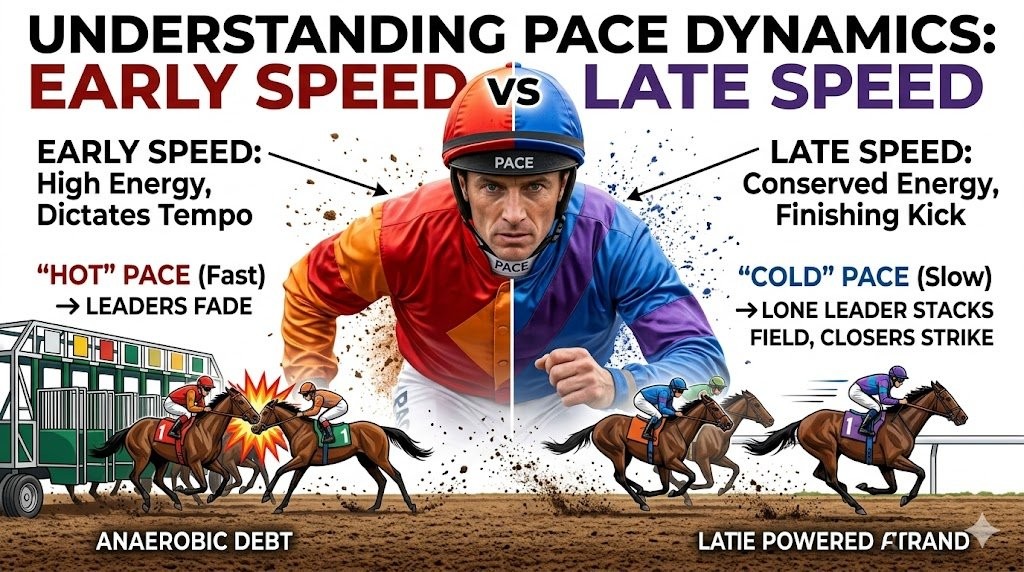
Early speed describes the ability of a horse to exert high levels of energy during the opening stages, typically from the break at the gate through the first quarter or half-mile. Horses endowed with significant early speed aim to establish a lead or “control the tempo,” allowing them to dictate the terms of the engagement. Late speed, conversely, refers to the finishing kick or closing ability. This is the energy a horse has conserved for the final stretch, often after settling in the rear or mid-pack to avoid the physical toll of the early “lead-foot” battles.
The tension between these two styles creates the “race shape.” A “fast pace,” often termed a “hot” pace, occurs when multiple front-runners contest the lead, forcing each other to run at unsustainably quick fractions. In such scenarios, the leaders often “fade” in the stretch as they enter anaerobic debt, allowing “closers” to pass them. A “slow pace,” or “cold” pace, is characterized by a lack of early pressure, allowing a lone front-runner to “stack the field” and conserve energy for a sprint to the wire.
The Physiology of Fading and Pace Pressure
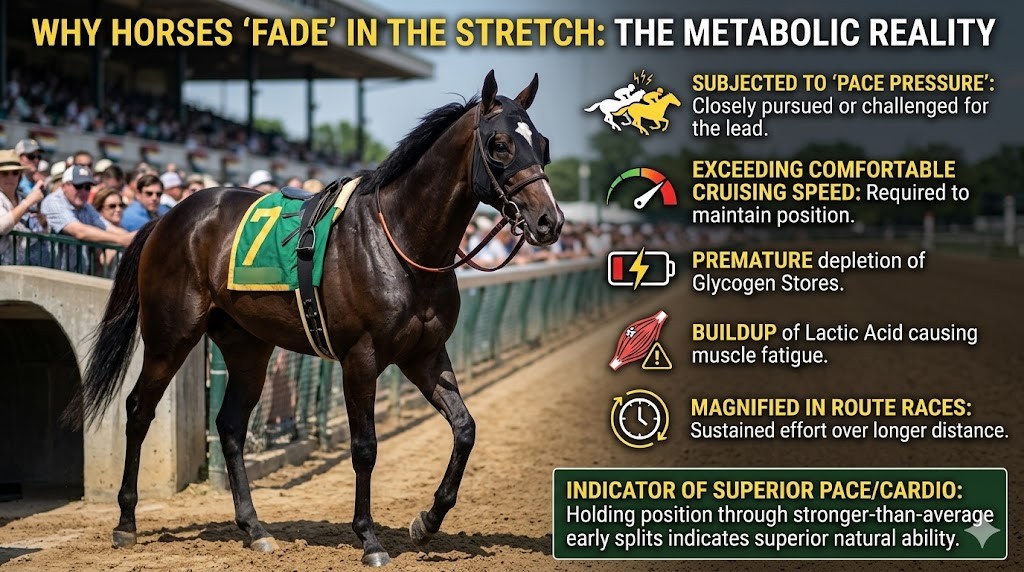
The phenomenon of a horse “fading” in the stretch is rarely a matter of a lack of will; it is a metabolic reality. When a horse is subjected to “pace pressure”—being closely pursued or challenged for the lead—it must often exceed its comfortable “cruising speed”.
This sustained exertion leads to the premature depletion of glycogen stores and a buildup of lactic acid. In route races, this effect is magnified, as the horse must sustain its effort over a longer distance. If a horse regularly holds its position through stronger-than-average early splits, it indicates superior natural pace and cardiovascular capacity.
Taxonomy of Running Styles and Tactical Positioning
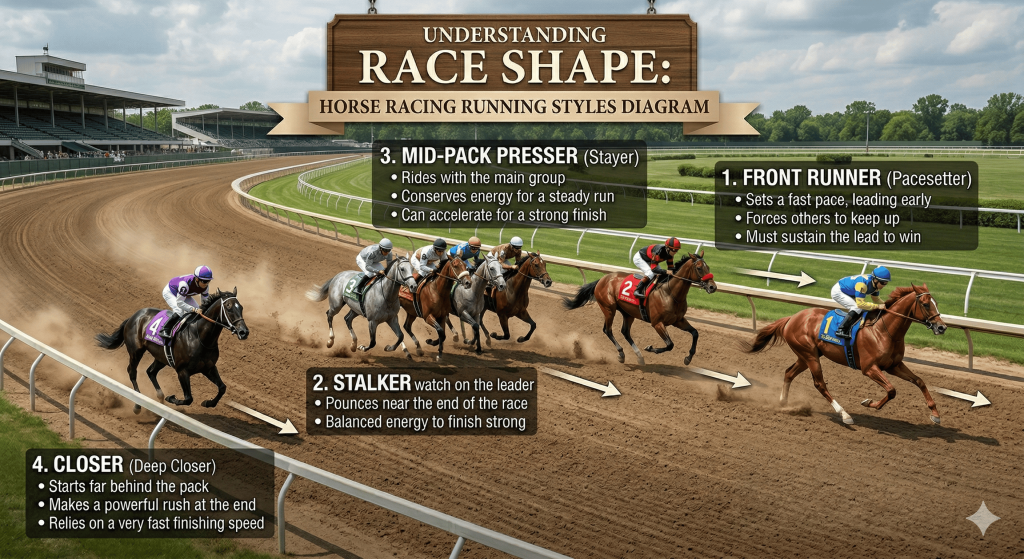
To project how a race will unfold, the analyst must categorize every entrant by its preferred running style. While nomenclature varies across the industry, four primary categories are standard.
The interaction of these styles is the engine of pace handicapping. For example, a “stalker” is often in an ideal position if the early pace horses tire, as they are close enough to the lead to take over without having to make up the massive ground required of a “deep closer”. Conversely, if there are no true front-runners in a race, a “presser” with the best early speed figure may “steal” the race by assuming the lead by default.
Daily Racing Edge (DRE) Betting Insights

The Front-Runner, designated as Early (E) speed, is a horse that must establish the lead or stay within a single length of it to be truly effective. Their primary tactical objective is to dictate the tempo of the race from the moment the gates open, forcing the rest of the field to react to their pace. When reviewing past performance charts, you can easily identify this aggressive running style by looking for comments such as “made all,” “led,” “set pace,” or “disputed lead.”
DRE Opinion: The absolute best time to back a pure Front-Runner is when the past performances scream “lone speed.” If you scan the field and see no other E-designated horses to challenge them early, they are primed to control the clock and wire the field. Additionally, keep an eye out for front-runners dropping in class; early speed is a lethal, often insurmountable weapon against cheaper company.
The Stalker, known by the Early Presser (EP) designation, prefers a more strategic position just behind the pacesetters. These horses typically sit one to three lengths off the front-runner, staying out of the exhausting early speed duels but remaining perfectly positioned to pounce the moment the leader begins to tire. In racing charts, Stalkers are often marked by phrases like “tracked leaders,” “pressed,” or “raced second.” DRE Opinion: Stalkers offer massive value when you project a contested pace up front. If the form shows two or three Front-Runners locked in a likely speed duel, back the Stalker. Look for EP horses whose recent charts show they can comfortably rate just off hot fractions and still possess the finishing kick needed to put the race away at the top of the stretch.
The Mid-Pack runner, or Presser (P), operates from the middle of the field, usually sitting about four to seven lengths back from the early lead. Their tactical objective is to remain completely unhurried and relaxed through the opening stages of the race, saving their energy and cardiovascular stamina for a sustained run starting at the far turn. Chart comments that point to a Mid-Pack style include “settled,” “mid-division,” or “followed pace.” DRE Opinion: Pressers are your bread-and-butter in route races featuring an honest, but not suicidal, pace. Comb the past performances for a Mid-Pack runner showing steadily improving late-pace figures. They are also fantastic “bounce-back” bets if their last chart notes a troubled trip—like being boxed in or checking hard—but they still managed to finish the race willingly.
Finally, the Closer, holding the Sustainer (S) designation, is a horse that comfortably hangs at the very rear of the field during the early and middle stages of a race. This running style is highly dependent on the race shape, relying heavily on a “pace meltdown”—where the front-runners exhaust themselves in a fast early tempo—to catch the tiring leaders in the final stretch. You can spot a Closer in the charts through descriptions like “closed late,” “trailing,” or “swooped from rear.” DRE Opinion: Only pull the trigger on a pure Closer when you are absolutely convinced a pace meltdown is imminent. The form must show a field loaded with aggressive early speed that will self-destruct. Furthermore, verify their final fraction times in recent starts and ensure they have a proven track record of successfully navigating traffic, as they will inevitably need to weave through a wall of tiring horses.
Analyzing the “Lone Speed” Scenario
One of the most potent angles in horse racing is the identification of “lone speed.” This occurs when only one horse in the field possesses a definitive front-running (E) style. Without other horses to apply pace pressure, the lone leader can relax, saving energy for the latter stages of the race. Statistics suggest that a lone front-runner, even if stepping up in class or possessing slightly inferior speed figures, is extremely dangerous and often wins at odds that do not reflect its tactical advantage.
Quantitative Metrics: Decoding Pace Figures and Sectionals
Before the digital era, handicappers had to manually calculate their own pace ratings. Today, proprietary algorithms from providers like Brisnet, TimeformUS, and EquinEdge have automated this process, though a deep understanding of the underlying math remains essential for the sharp player.
The Brisnet Pace Rating System

Brisnet utilizes a fixed scale of two points per length to measure velocity at various “points of call”.
- E1 (First Call): Measures speed from the starting gate to the first call—2 furlongs in sprints and 4 furlongs in routes.
- E2 (Second Call): Measures speed from the start to the second call—4 furlongs in sprints and 6 furlongs in routes.
- Late Pace (LP): Measures the horse’s velocity from the pre-stretch call to the finish line.
A horse that consistently posts triple-digit E1 and E2 ratings is a “speed demon” that must be accounted for in any pace map. However, if a horse shows a significant “drop-off” in its LP numbers compared to its early ratings, it signals a vulnerability to pressure or a lack of stamina at the current distance.
TimeformUS and Pace-Adjusted Speed Figures
TimeformUS offers a revolutionary departure from traditional speed figures like the Beyer Speed Figure (BSF). While a Beyer figure is based purely on the final time and a track variant, TimeformUS incorporates pace and weight carried into the final number.
If a front-runner “gets away” with a slow early pace, TimeformUS algorithms will “downgrade” its final speed figure, recognizing that the performance was aided by an easy trip. Conversely, if a horse chases a “hot” pace—defined by high early pace figures—its final speed figure will typically be “upgraded” to reflect the difficulty of its effort.
Consider the case of a horse carrying 127 pounds that finishes a nose ahead of a horse carrying 116 pounds. In a Beyer world, both might receive a 104. In the TimeformUS model, the horse carrying the heavier weight would receive a significantly higher figure (e.g., 116 vs. 109) to account for the extra burden it overcame. This distinction is vital for “sharp” players who look for value on horses that were “better than their last race” due to pace or weight factors.
The Mathematics of Par Times
To determine if a pace is fast or slow, the analyst must compare the observed fractions to “pars”—the average times for that specific class level and distance at that particular track.
| Class Level | 1/4 Mile Par | 1/2 Mile Par | 6-Furlong Final Par |
| Stake-Graded | :21.6 | :44.2 | 1:08.6 |
| Allowance (NW3) | :21.7 | :44.5 | 1:09.2 |
| $40k Allowance | :21.8 | :44.6 | 1:09.4 |
| $25k Claiming | :22.0 | :44.9 | 1:10.0 |
| $10k Claiming | :22.2 | :45.5 | 1:11.2 |
| Maiden Special Weight | :21.8 | :44.6 | 1:09.4 |
Note: Par times are based on sample dirt sprint data for older colts and geldings. Adjustments of 0.1 seconds are made for different class levels and 0.2 seconds for final times.
A :22.0 opening quarter in a 10,000 claiming race is a “true” or “honest” pace, but in a Graded Stake, it would be considered exceptionally slow, gifting the leader a massive advantage. Understanding these pars allows a player to spot when a horse’s early fractions were “inflated” by weak competition or “deflated” by a truly elite field.
Environmental and Surface Modifiers: Track Bias and Maintenance
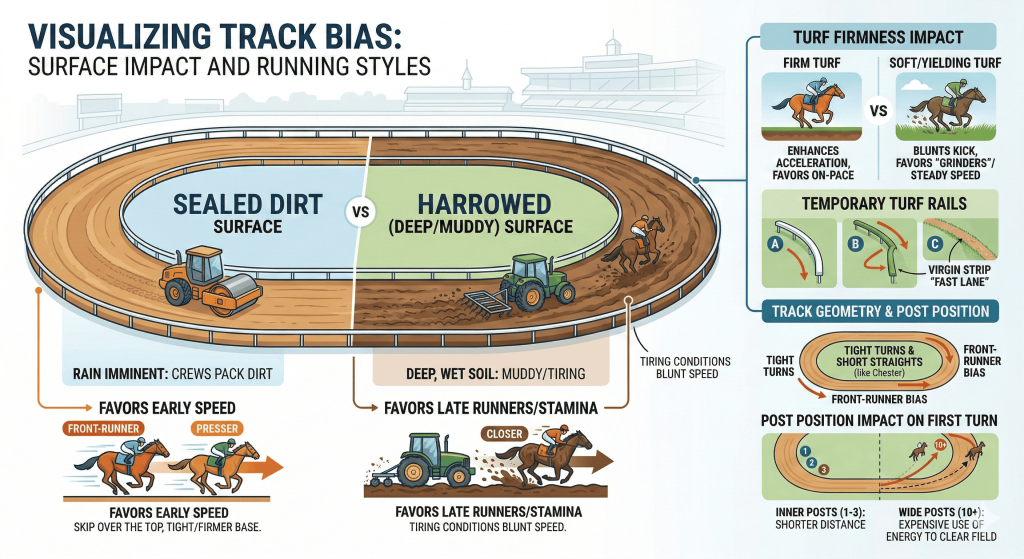
Pace does not exist in a vacuum; it is mediated by the surface upon which the race is run. “Track bias” refers to the tendency of a racing surface to favor specific positions or running styles.
The Impact of Surface and Weather
- Sealed Dirt: When rain is imminent, track crews pack the dirt down to prevent water from soaking into the base. A “sealed” track often becomes tighter and firmer, favoring horses with early speed who can “skip” over the top.
- Muddy vs. Sloppy: A “sloppy” track (sealed with water on top) often plays differently than a “muddy” track (deep, wet soil). Muddy tracks can be tiring, favoring late runners who possess superior stamina.
- Turf Firmness: On grass, “firm” going enhances acceleration and often favors on-pace horses. “Soft” or “yielding” turf blunts a horse’s kick and can favor “grinders” who maintain a steady, high-cruising speed.
The Geometry of the Track and Post Position
The configuration of the track itself alters pace dynamics. Tracks with “tight turns” and “short straights,” such as Chester or Epsom, make it notoriously difficult for closers to make up ground, creating a heavy bias for front-runners. Furthermore, the “short stretch” geometry at tracks like Oaklawn Park (where the finish line for 1 1/16-mile races is set at the first finish line) forces jockeys to make their moves earlier than they would at a track like Churchill Downs.
Post position also plays a critical role in the first turn. Horses drawn in the “inner” posts (1-3) have the shortest distance to the first bend, allowing them to secure a position while using less energy. A front-runner drawn wide (e.g., post 10 or 11) must expend significant energy to “clear” the field before the first turn or risk being “trapped wide,” covering extra ground that can prove fatal in the stretch.
The “Rail Effect” and Temporary Turf Rails
On turf courses, management often moves temporary rails outward to protect the inner grass from damage. While some data suggests rail settings do not have a major correlative effect on the winner’s running style, others argue that moving the rail creates a “virgin strip” of ground that can act as a “fast lane,” favoring horses positioned near it. In Hong Kong, the “A to B to C” rail movement is a logical progression that bettors must track to identify where the fastest ground is located.
Intermediate Handicapping: Projections and Distance Dynamics
A horse’s pace profile often changes as it moves between different distances. A “sprint specialist” possesses explosive early speed but may “hit a wall” when asked to go beyond 7 furlongs. Conversely, a “router” may look “dull” in the opening stages of a sprint but is perfectly suited for the sustained rhythm of a 1 1/8-mile race.
Prototypical Fractional Times by Distance
To project race flow, the analyst uses a “Points of Call” chart to understand where the timing sensors are located.
| Distance | 1st Call | 2nd Call | 3rd Call | Stretch | Finish |
| 6 Furlongs | 1/4 Mile | 1/2 Mile | — | Stretch | Finish |
| 1 Mile | 1/4 Mile | 1/2 Mile | 3/4 Mile | Stretch | Finish |
| 1 1/16 Mile | 1/4 Mile | 1/2 Mile | 3/4 Mile | Stretch | Finish |
| 1 1/4 Mile | 1/4 Mile | 1/2 Mile | 1 Mile | Stretch | Finish |
Note: In longer routes (1 1/8 to 1 1/2 miles), the first recorded fractional time often begins at the 1/2 mile mark rather than the 1/4 mile mark.
Distance Changes and Pace Sensitivity
When a horse “stretches out” from a sprint to a route, the critical question is whether it can “rate”—relax and settle behind other horses without fighting the jockey. A front-runner that was used to $:22.1$ quarters in sprints may find the $:23.4$ opening quarters of a route race to be “walking,” allowing it to lead easily and save energy. However, if that horse is a “one-dimensional” speedster that refuses to settle, it will likely “bolt” to a massive early lead and collapse long before the wire.
Advanced Market Analysis: Odds, Efficiency, and Circuit Variance
The “sharpest” players do not just look for the horse most likely to win; they look for the horse whose tactical advantage is not “priced into” the odds.
Is Pace Advantage Already Priced In?
Traditional speed figures are the “currency” of the betting public. If you simply bet the horse with the highest speed figure in every race, you will likely achieve a $30-35\%$ win rate but a flat-bet loss, as these horses are overbet, driving payouts down.
Pace analysis, however, remains a more nuanced and “hidden” layer of handicapping. Because many bettors ignore race shape, a “lone speed” horse at $5/1$ or a “closer” in a speed-duel-heavy field at $10/1$ represents significant value. Research into the “Favorite-Longshot Bias” indicates that the betting public consistently overbets longshots (due to risk-seeking behavior) and underbets favorites, particularly those with a clear tactical edge.
The Challenge of Circuit Consistency
Pace figures are not always consistent across different geographical circuits. A “100” pace rating in Southern California (CA) may not represent the same level of exertion as a “100” in New York (NY) or Kentucky (KY).
- California Tracks: Known for being “quick” and “hard,” often producing high early speed ratings that may be slightly inflated compared to the “deeper” paths in the East.
- New York/Aqueduct: Winter tracks with “deeper footing” often produce lower raw speed numbers, requiring figure-makers to award a “boost” to these horses when they travel to faster tracks.
- Florida/Gulfstream: Often plays extremely fast, favoring “speed-on-speed” styles. A horse earning a career-best figure here might find the “deep dirt” of Oaklawn or the “sweeping turns” of Belmont much more taxing.
Sophisticated bettors use “track variants” and “circuit pars” to normalize these differences, ensuring they don’t overvalue a horse that has spent its career running on “conveyor belt” surfaces.
The Anatomy of a Pace Meltdown: Turning Chaos into Opportunity
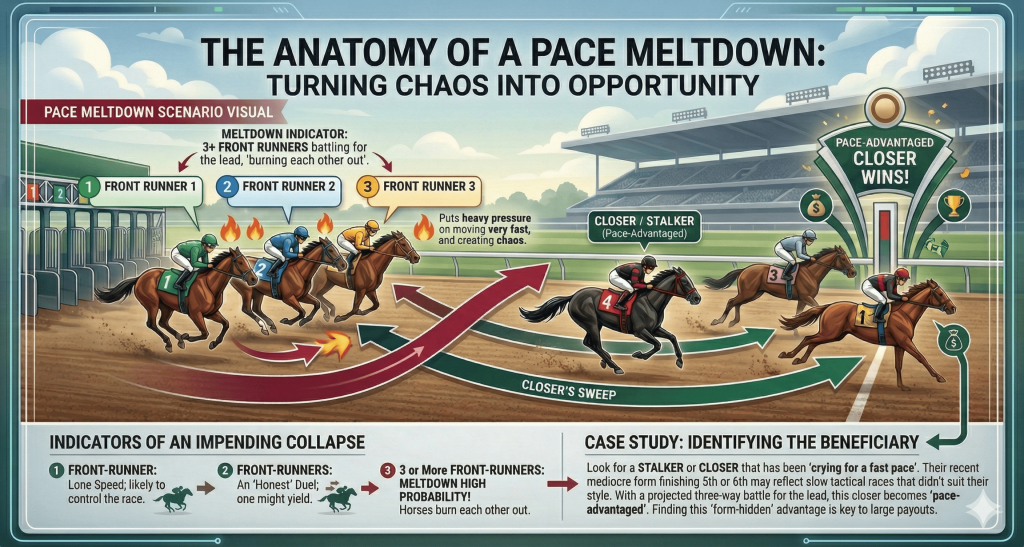
A “pace meltdown” is the handicapper’s holy grail. It occurs when the number of horses vying for the lead exceeds the physical limit of what the track can sustain.
Indicators of an Impending Collapse
Analysts identify a potential meltdown by tallying the “confirmed” front-runners.
- 1 Front-Runner: Lone speed; likely to control the race.
- 2 Front-Runners: An “honest” duel; both may survive, but one usually yields in the stretch.
- 3 or More Front-Runners: High probability of a meltdown. These horses will “burn each other out” through the first half-mile, setting the stage for a closer to sweep past the exhausted leaders.
Case Study: Identifying the Beneficiary
In a race loaded with speed, the player must look for the “stalker” or “closer” who has been “crying for a fast pace”. For example, a closer’s recent form might look mediocre (e.g., finishing 5th or 6th) because its previous races were slowly run tactical affairs that didn’t suit its style. If today’s race shape projects a three-way battle for the lead, that closer is now “pace-advantaged.” This “form-hidden” advantage is where the largest payouts in racing are found.
The Strategic Framework: The 5 Most Important Pace Questions

To achieve consistent profitability, the analyst must apply a repeatable framework to every race.
- Who is going to the lead? Use early pace ratings and running styles to identify the probable leader(s).
- Will that horse be pressured? Determine if there are other “E” types that will force the leader to run faster than par.
- How fast will the first quarter and half be relative to par? Use the class-level par charts to project the difficulty of the opening splits.
- Which horses benefit from this projected scenario? Identify if the race favors the “lone speed” or the “deep closer”.
- Is the betting public overestimating or underestimating the pace impact? Compare your projected “fair odds” to the actual “tote board” to find value.
The “OPI” and Developing Contenders
Advanced players often use an Overall Performance Index (OPI) to simplify conflicting data points. The OPI weights recent speed figures ($3$ outings), competitive grade (class), and pedigree potential into a single number. A horse whose OPI has increased in three consecutive starts is a “developing” contender that the public often overlooks, especially if those improvements were masked by difficult pace scenarios.
The Statistical Reality: Why Front-Runners Win More Sprints
Data from major racing jurisdictions consistently reveals that “pace wins the cash.” In sprint races (up to 1200m), front-running types dominate irrespective of the early pace.
The Impact Value (IV) of Position
Impact Value (IV) measures how frequently horses from specific positions win relative to their representation in the field.
$$IV = \frac{\% \text{ of wins from position}}{\% \text{ of runners from position}} \times 100$$
- IV > 100: Positive bias (the position wins more than its fair share).
- IV < 100: Negative bias (the position underperforms).
| Course Type | Position / Style | Impact Value (Approx.) | Strike Rate |
| Sharp (Chester) | Front-Runner (Stalls 1-3) | $200+$ | $32\%$ |
| Galloping (York) | Hold-Up / Closer | $120$ | $20\% \text{ improvement}$ |
| National Average | All-The-Way Leader | $180$ | $15-25\%$ |
| National Average | Backmarkers / Closers | $30$ | $3-8\%$ |
This statistical reality explains why “pace handicapping” is the primary weapon of the professional. While the “closer” is visually appealing, it wins significantly less often than its “on-pace” counterpart. A horse $6$ lengths off the lead in a slow-paced sprint must run its final 600m in approximately $33$ seconds to catch a leader running in $34$ seconds. Only elite Thoroughbreds are capable of such a sustained “turn of foot,” making the task mathematically impossible for most.
The Visual Evidence: Paddock Analysis and Pace Readiness
A horse’s physical demeanor in the paddock often serves as a proxy for its “pace readiness.” Horses are herd animals, and their position in the running order is often a reflection of their social standing within the herd.
Identifying the Confident Front-Runner
A horse that is “ready to roll” will often show a “bright, inquisitive eye,” “ears pricked forward,” and a “neck slightly arched”. Conversely, horses “sweating profusely” or “shaking their heads” may be using up their precious energy before the race even starts. The professional analyst watches the “post-parade” for a horse that “lovels” into a lope within one stride, indicating a focused mind and a body prepared for the anaerobic demands of a fast break.
The “Hot Springs Bottom” and Cardiovascular Fitness
In some instances, the physical preparation of a horse is circuit-specific. Training on the “deep dirt” of Oaklawn Park develops a specific type of cardiovascular fitness known as “Hot Springs bottom”. This fitness allows horses to handle the grueling pace of the Triple Crown trail, as the surface acts as a “physical filter” that separates “pretenders from genuine classic stayers”.
Practical Integration: Constructing a Pace-Based Betting Strategy
A successful handicapper synthesizes all the aforementioned data into a cohesive betting plan.
- Analyze the Field’s Running Styles: Assign an ESP designation to every horse.
- Project the Race Shape: Is it a EEE (meltdown) or a Lone E (steal)?.
- Evaluate Track Bias: Check if the current surface favors speed or closers.
- Identify Value: Look for horses whose “hidden” pace advantages are not reflected in the odds.
- Use Multi-Race Wagers: Use pace-advantaged “key” horses to build Pick 4 and Pick 5 tickets.
By moving beyond simple “final time” analysis and embracing the kinetic reality of pace, the handicapper gains an edge over the general public. Pace is the quiet engine that drives every outcome in Thoroughbred racing. Whether it is a “tactical crawl” or a “blistering speed duel,” the horse that manages its energy most efficiently will always hold the advantage. In a sport where inches often separate victory from defeat, pace analysis provides the definitive framework for finding the winners.