
The Pick 5: Horse Racing’s Sweet Spot Bet
For serious horseplayers, not all wagers are created equal.
Every racetrack offers a long list of betting options—Pick 3s, Pick 4s, Pick 5s, Pick 6s, exactas, trifectas, and more. But among experienced handicappers, one wager has quietly become the most balanced bet in racing.
That wager is the Pick 5.
The Pick 5 sits in a unique place on the betting spectrum. It offers payouts large enough to matter, difficulty that rewards good handicapping, and a takeout structure that allows skilled players to keep more of their money in the pool.
In short, many professionals consider the Pick 5 the sweet spot of multi-race wagering.
Pick 5 – Podcast
Why the Pick 5 Hits the Sweet Spot
Multi-race wagers all fall somewhere on the risk-reward spectrum.
At one end are shorter bets like the Pick 3 and Pick 4. These sequences are easier to hit, but the payouts can be disappointing when favorites win.
Horseplayers often call these outcomes “chalky sequences.” When logical horses dominate the results, the payoff pool spreads across too many winning tickets.
At the opposite extreme sits the Pick 6, racing’s historic jackpot bet. While Pick 6 carryovers can produce huge payouts, selecting six straight winners—often from large fields—is extremely difficult for an individual bettor.
That leaves the Pick 5 right in the middle.
Five races are enough to generate large payoffs, but not so many that the wager becomes almost impossible to solve.
For disciplined handicappers, this balance creates opportunity.
Why Pick 3 and Pick 4 Often Disappoint
Shorter sequences attract many bettors because they feel easier to solve.
But that same accessibility often suppresses the payouts.
When heavy favorites win two or three consecutive races, large numbers of tickets remain alive. The final payoff is divided among too many winning players, shrinking the return.
Racing analytics studies have repeatedly shown this pattern: consecutive favorites dramatically reduce profitability in short multi-race wagers.
For players trying to generate long-term profit, this structural issue becomes difficult to overcome.
The Single Takeout Advantage
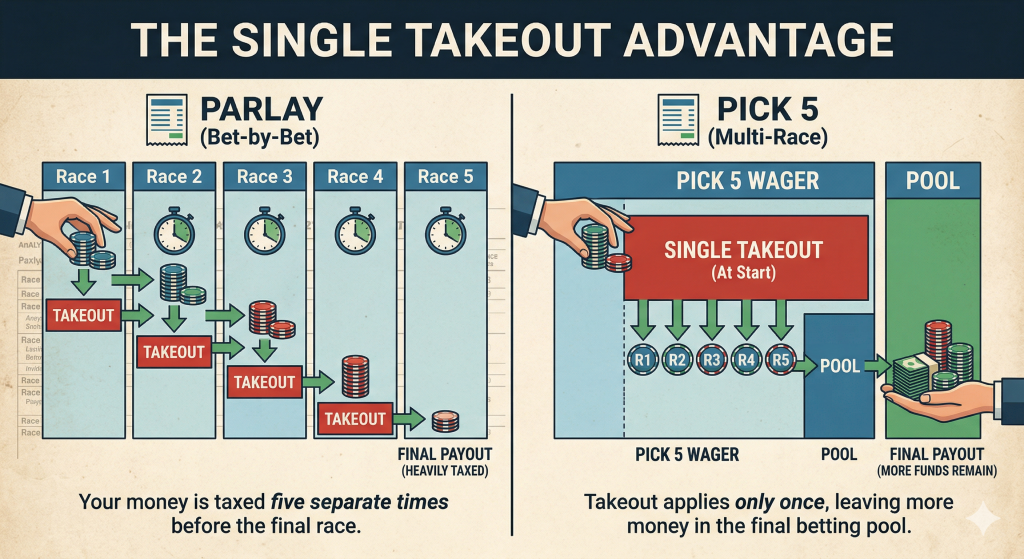
One of the biggest economic advantages of the Pick 5 is something many bettors never consider.
Takeout friction.
If you attempted to build your own Pick 5 by betting a horse to win and then parlaying those winnings into the next race, your money would be taxed five separate times by the track takeout.
But a Pick 5 ticket only applies takeout once, at the beginning of the wager.
That difference allows more money to remain in the betting pool and gives skilled handicappers a mathematical edge over time.
Typical Pick 5 Takeout Rates
Many tracks have lowered Pick 5 takeout in recent years because the wager attracts serious bettors.
Examples across major circuits include:
| Track | Pick 5 Takeout | Notes |
|---|---|---|
| Laurel Park | 12% | One of the lowest in racing |
| Tampa Bay Downs | 15% | Lower than their Pick 4 |
| Mahoning Valley | 15% | Often lighter CAW participation |
| Gulfstream Park | 15% | Offers a Retail-Only Pick 5 |
| Fair Grounds | 15% | Reduced to attract betting volume |
| Oaklawn Park | 15% | Competitive takeout for major circuit |
| Turf Paradise | 15% | Included in cross-country wagers |
| Parx Racing | 15% | Strong value compared to Pick 4 |
Lower takeout means less friction between your bankroll and potential profit.
Pick 5 Rules Every Bettor Should Know
Understanding how the wager works is just as important as handicapping the races.
Because the Pick 5 spans five consecutive races, racetracks must account for real-world racing issues like scratches, weather changes, and carryovers.
Here are the key rules every bettor should know.
The Five-for-Five Rule
The Pick 5 is a perfect sequence wager.
To win the main pool, you must correctly select the winner of all five races.
Unlike some Pick 6 wagers, most Pick 5 bets do not pay consolation prizes. Miss one race and your ticket is eliminated—unless nobody hits the full sequence.
What Happens If Your Horse Scratches?
Late scratches are common in racing.
When a horse you selected scratches after you purchase your Pick 5 ticket, your selection is usually replaced by the post-time favorite.
This rule keeps your ticket alive, but it has a downside. If the favorite wins, thousands of other bettors may also advance, which can reduce the final payout.
What Happens When Turf Races Move to Dirt?
Weather can force turf races onto the main track.
If the surface change occurs before the Pick 5 begins, bettors simply handicap the race on the new surface.
But if the change occurs after the sequence has started, many tracks declare the race an “All-Win” leg.
In that case, every ticket automatically advances.
While this keeps bettors alive, it effectively reduces the wager from a five-race challenge to four races—often lowering the final payoff.
Carryovers: When the Pool Gets Big
If nobody selects all five winners, the remaining pool money carries over to the next racing day.
Carryovers attract massive betting interest because players know the pool already contains extra money.
A $50,000 carryover can easily grow into a betting pool worth several hundred thousand dollars.
Mandatory Payout Days
At the end of some racing meets, tracks declare a mandatory payout.
On those days, the entire Pick 5 pool must be distributed.
If nobody hits five winners, the money is paid to the tickets with the most correct selections.
Mandatory payout days often produce some of the largest betting pools of the season.
How Professionals Build Pick 5 Tickets
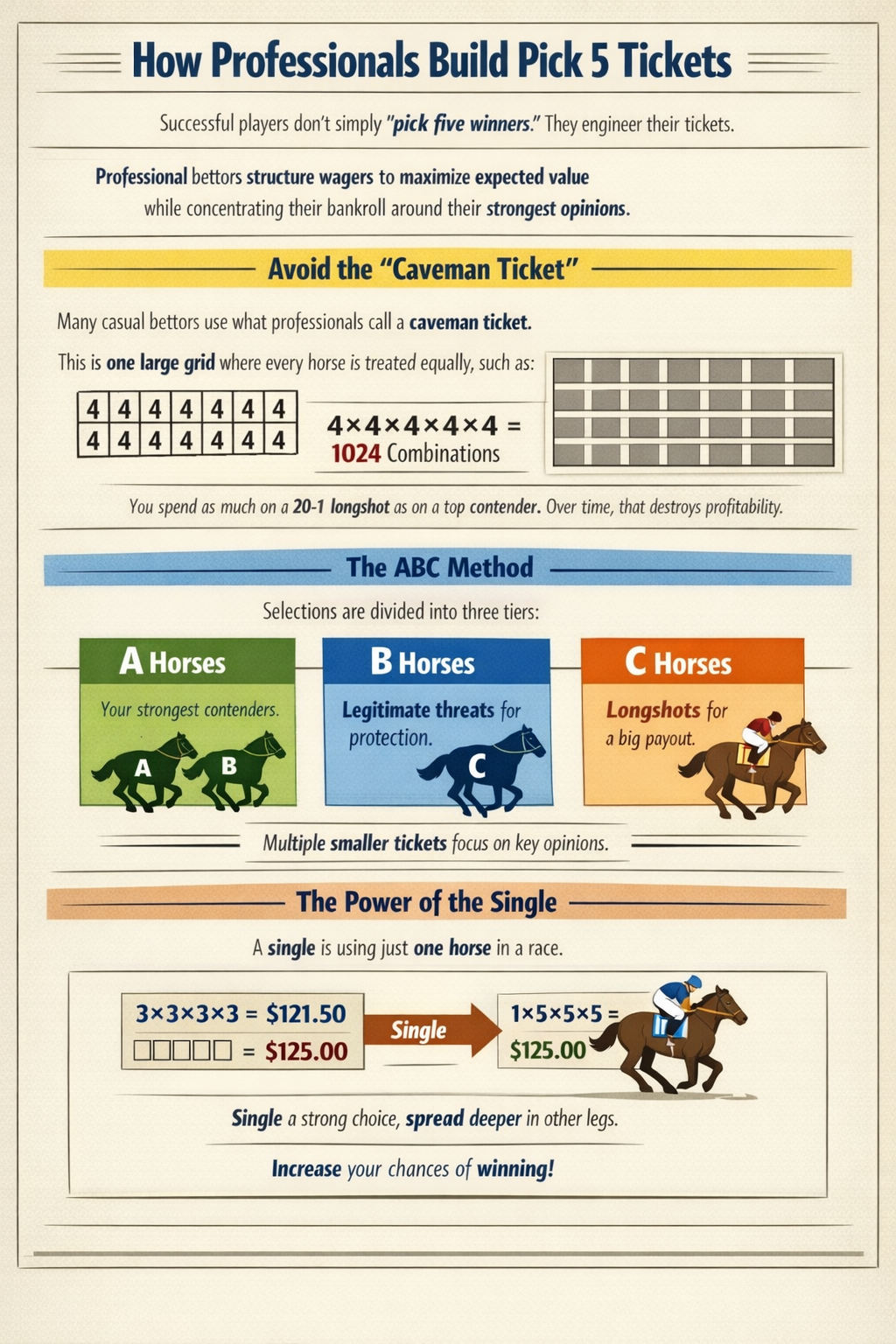
Successful players don’t simply “pick five winners.”
They engineer their tickets.
Professional bettors structure wagers to maximize expected value while concentrating their bankroll around their strongest opinions.
Avoid the “Caveman Ticket”
Many casual bettors use what professionals call a caveman ticket.
This is one large grid where every horse is treated equally, such as:
4 × 4 × 4 × 4 × 4
The problem is obvious.
You end up spending the same amount of money on a 20-1 outsider as you do on your top contender.
Over time, that destroys profitability.
The ABC Method
Professional bettors often use the ABC Method, popularized by racing analyst Steve Crist.
Selections are divided into three tiers:
A Horses
Your strongest contenders.
B Horses
Legitimate threats you want for protection.
C Horses
Longshots that could produce a huge payout.
Instead of one large ticket, players construct multiple smaller tickets that emphasize their strongest opinions.
The Power of the Single
The most powerful tool in Pick 5 betting is the single.
A single means using only one horse in a specific race.
By singling a strong opinion, bettors can spread deeper in the other races without exploding the ticket cost.
For example:
A ticket using three horses in five races costs $121.50 at a 50-cent base.
But if you single one race, you can cover five horses in the other four races for roughly the same cost.
This dramatically increases your chances of surviving chaotic races.
Why the Pick 5 Rewards Skilled Handicappers
Racetracks intentionally structure Pick 5 sequences with different types of races.
You might see:
- Turf routes
- Dirt sprints
- Claiming races
- Allowance races
- Stakes events
Each race requires a different handicapping approach.
Professional players adapt accordingly:
- Turf races: emphasize closing speed and pedigree
- Dirt sprints: focus on early pace
- Claiming races: analyze trainer intent and form cycles
- Stakes races: evaluate class and trip history
When bettors combine those skills with smart ticket construction, the Pick 5 becomes more than a bet.
It becomes a strategic puzzle—and one of the most rewarding wagers in horse racing.
The Pick 5 “Edge” FAQ: Tools, Tactics, and Truths
That is known as a “caveman” ticket, and yes, it’s a mathematical disadvantage. By weighting all horses equally, you overpay for your weakest opinions. Professionals use the ABC Method to separate primary contenders (As) from backups (Bs) and longshots (Cs)
The Pro Move: Use DRF TicketMaker to automatically break your selections into multiple “high-value” tickets that focus your budget where your conviction is strongest.
Further Reading: If you’re new to this, start with the TwinSpires Pick 5 Step-by-Step guide. To master the math, dive into the AmWager ABC Guide.
They make it harder by “mining” value out of the pool, but you can fight back with the same data.
Betmix: Use their “Slider” technology to weigh over 40 factors like speed and trainer stats to find overlays the public misses.
EquinEdge: Leverage AI metrics to find “Positive Expected Value” (+EV) where the potential payout exceeds the mathematical risk.
Post Time Daily: For the true “data junkies,” this provides raw .PTD2 and .txt files to power your own custom handicapping models.
It matters immensely because of Takeout (the track’s commission). A 25% takeout will destroy your bankroll three times faster than a 15% rate.
The Value King: Laurel Park offers an industry-low 12% Pick 5 takeout.
The Safe Haven: Check the NYRA Wagering Info to find “Retail Only” pools where CAW bots are barred, significantly increasing your potential payout.
The Rulebook: Always check the Del Mar Wagering Menu to see the latest “guardrails” protecting you from late odds shifts.
You likely played in a pool dominated by CAW algorithms that “flatten” the payouts.
The Proof: A landmark BloodHorse Study found that “Retail Only” pools paid 3.8x more than a win parlay, while CAW-heavy pools paid only 1.2x.
The Deep Dive: For a full understanding of how these groups impact your wallet, read Past The Wire’s analysis on Solving the CAW Problem