
Horse Racing Claiming Shake: Exploiting Racing’s Most Powerful Market Signal
While the “shake” is often a quiet procedural event in the racing office, claiming shake has been the catalyst for some of the most legendary rags-to-riches stories in horse racing history. In these cases, the shake was the moment a “cheap” horse was transformed into a champion.
The Legendary Shake for “Shake You Down”
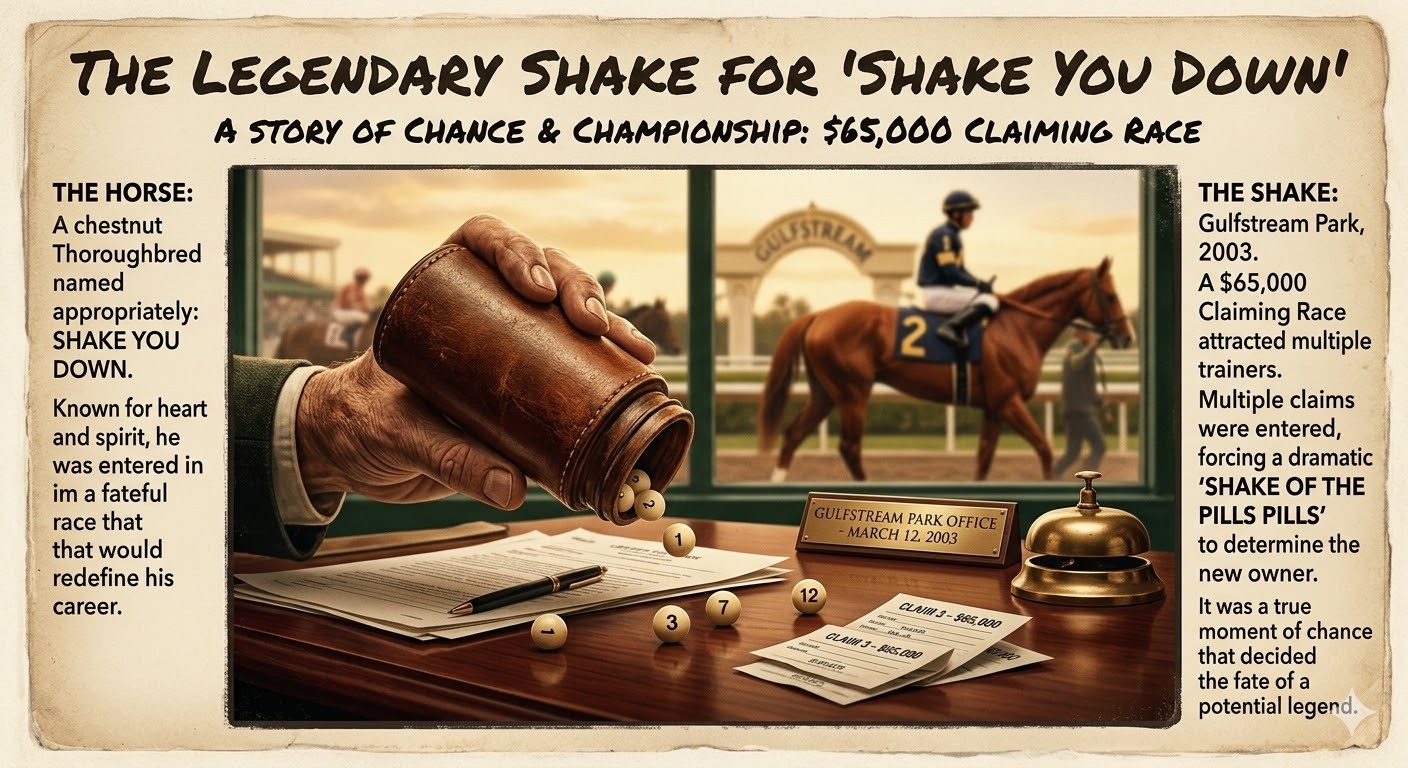
Perhaps the most famous story of a shake involves a horse appropriately named Shake You Down. In 2003, the horse was entered in a $65,000 claiming race at Gulfstream Park.
The Shake: Multiple trainers recognized the horse was better than the price tag. A massive “shake” occurred, and trainer Scott Lake won the draw.
The Result: Immediately after being claimed, the horse went on a tear, winning the Grade 2 General George Handicap and the Grade 2 True North. He eventually earned over $1.4 million and became one of the top sprinters in America.
The Lesson: This is the ultimate “Moneyball” story—a horse that was essentially “purchased at a discount” in a lottery went on to compete in the Breeders’ Cup.
Charismatic: From a Claiming Tag to the Kentucky Derby
While not every start involved a multi-way shake, Charismatic is the poster child for the “unclaimed” value that drives shake-bettors crazy.
The Near-Miss: Legendary trainer D. Wayne Lukas famously ran Charismatic in a $62,500 claiming race just months before the 1999 Kentucky Derby.
The Drama: At that time, nobody “dropped a claim” (entered a shake) for him. Trainers looked at him and passed.
The Payoff: Charismatic went on to win the Kentucky Derby and the Preakness Stakes, falling just short of the Triple Crown.
The Betting Angle: Handicappers who track “shakes” use this story as a warning: if a horse shows high-quality figures in a claiming race and doesn’t get claimed, it’s a red flag. But if a horse like Charismatic had gone through a 5-way shake, the “smart money” would have been all over him in the Derby.
Lava Man: The $50,000 Claim That Won $5 Million
Lava Man is widely considered the greatest claim in the history of the sport.
The Claim: He was claimed for $50,000 in 2004 at Del Mar.
The Market Signal: While it wasn’t a record-breaking number of people in the shake, the trainer who took him, Doug O’Neill, saw something the public didn’t.
The Result: Lava Man became a Hall of Fame runner, winning the Santa Anita Handicap three times and earning over $5.2 million.
The Legend: He is the only horse to win a Grade 1 race on dirt, turf, and synthetic surfaces.
The “Stymie” Legacy
Going back further into history, the horse Stymie (claimed in 1943 for $1,500) became the first horse in history to surpass $900,000 in earnings.
The Strategic Shake: Trainer Hirsch Jacobs was a “claiming king.” He thrived on the “shake” era, often claiming horses back and forth from rivals. He used the shake as a tool to “rescue” horses from trainers he felt were mismanaging them.
The Impact: Stymie became “The People’s Horse,” and his success solidified the idea that a claiming race isn’t a “basement” for bad horses—it’s a testing ground for stars.
Why these stories matter for you:
In every one of these famous cases, the valuation was wrong. The betting public saw a “cheap claiming horse,” but the professional trainers saw an “undervalued asset.”
When you see a 3-way or 5-way shake today at a track like Gulfstream or Aqueduct, you are witnessing the beginning of a potential “Shake You Down” story. The trainers are effectively saying, “The public thinks this horse is worth $20k, but we know it’s worth $100k.” That is the exact moment you have the biggest edge over the house.
What Is A Shake In Horse Racing Claims
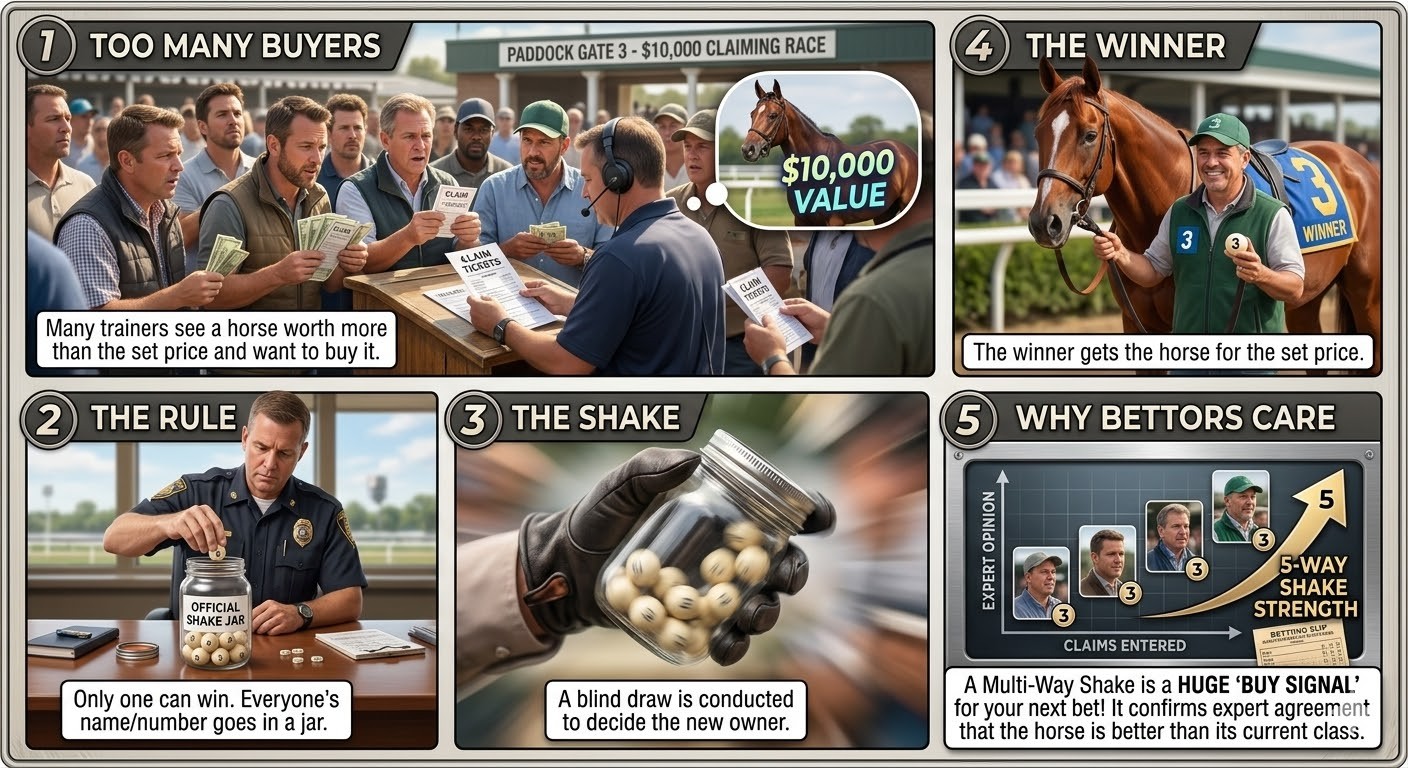
A shake is essentially a “blind draw” or a lottery to decide who gets to buy a horse.
Here is the simple breakdown of how it happens:
Too Many Buyers: In a claiming race, any horse in the race is for sale for a set price (e.g., $10,000). Sometimes, a horse looks like such a great deal that five different trainers all show up with $10,000 to buy it.
The Rule: Only one person can buy the horse. To make it fair, the racetrack officials don’t give it to the person who showed up first; they put everyone’s name (or a number representing them) into a small container.
The “Shake”: An official literally shakes the container and pulls out one name. That person wins the draw and gets the horse.
Why bettors care about it: If you see that a horse went through a “5-way shake,” it means five different professional trainers—who look at horses for a living—all looked at that horse and said, “This horse is worth way more than $10,000, and I’m willing to spend my own money right now to prove it.”
For a gambler, a shake is a huge “buy” signal. It tells you that the experts agree the horse is much better than its current competition, even if it didn’t win the race that day.
Can Shakes Make Money For You
Inside the high-stakes world of the “Claiming Crown,” most bettors are looking at the wrong data. They are staring at past performances and speed figures that everyone else has already seen. But there is a “hidden” market signal that bypasses the noise and speaks directly to the smart money: The Shake.
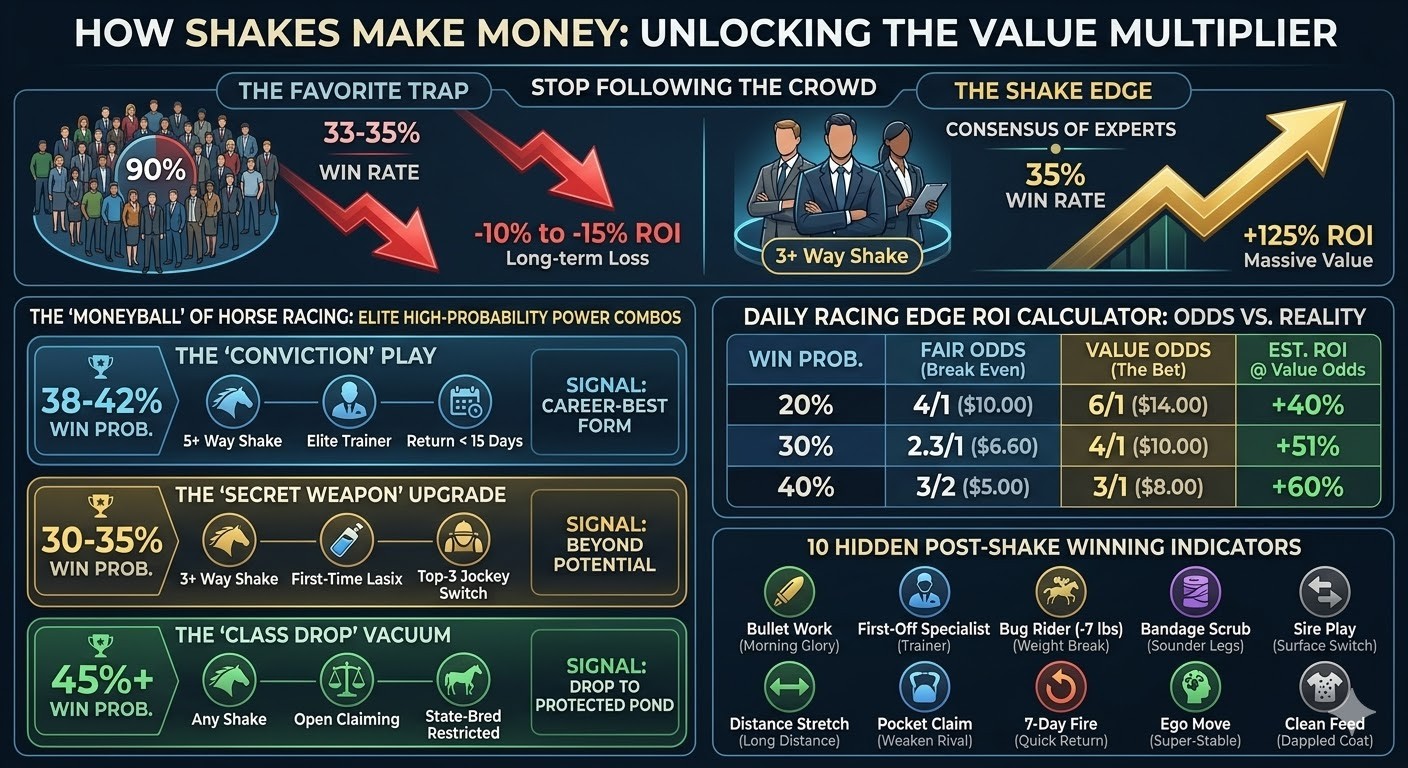
If you want to win consistently, you have to stop following the crowd. Consider the favorite: across North American racing, betting the favorite yields a win rate of roughly 33%–35%. While that sounds stable, it is a mathematical trap. Because the public hammers the favorite, the odds are crushed, resulting in a long-term ROI of -10% to -15%. You are essentially paying the track a tax to be “right” 1 out of 3 times.
The real money is found when professional valuation intersects with public oversight. When a horse goes through a “multi-way shake,” you aren’t just betting on a horse; you are betting on a consensus of experts who have put their own cold, hard cash on the line to own that animal.
The Value Multiplier: Probabilities vs. Price
The beauty of the “Shake Horse” is that the public often misses the upgrade. If you find a horse with a 32% win probability (like a 5-way shake or a major trainer upgrade) but the public lets them go at 4-1 ($10.00), you aren’t just gambling—you are exploiting a massive overlay.
The Favorite: 35% Win Rate at 6/5 Odds = Negative ROI
The Shake Combo: 35% Win Rate at 4/1 Odds = +125% ROI
By combining the 30+ variables we’ve identified—from equipment changes to “state-bred drops”—you can identify runners with a 40% win probability that the betting board treats like a 20% longshot. That gap is where professional bankrolls are built.
“Welcome to the ‘Moneyball’ of horse racing. Here is how you identify the elite 1% of claims and turn the ‘Shake’ into a high-yield engine for your bankroll.”
To truly capitalize on these signals, you must look for the “Value Gap”—the difference between a horse’s actual probability of winning and the price the public is offering. Below are the advanced combinations and metrics that move a horse from a “maybe” to a “must-bet.”
The High-Probability Power Combos Claim Races
When these factors intersect, the win probability compounds, often reaching levels that dwarf the 33% baseline of a standard favorite.
The “Conviction” Play (Prob: 38–42%): * Formula: 5+ Way Shake + Elite Trainer + Return within 15 Days.
The Logic: When five professionals fight for a horse and the winner immediately “wheels them back” in two weeks, it signals the horse is in career-best form and the trainer wants to recoup the investment while the “iron is hot.”
The “Secret Weapon” Upgrade (Prob: 30–35%):
Formula: 3+ Way Shake + First-Time Lasix + Jockey Switch to a Top-3 Rider.
The Logic: The shake proves the horse has talent; the Lasix fixes a physical limitation; the jockey switch proves the new barn is “sending” (betting on themselves).
The “Class Drop” Vacuum (Prob: 45%+):
Formula: Any Shake + Move from “Open” Claiming to “State-Bred” Restricted.
The Logic: You are taking a horse validated by the open market and dropping them into a protected “pond” where the competition is structurally slower.
The Daily Racing Edge – ROI Calculator: Odds vs. Reality
In the “Moneyball” approach, we don’t care who should win; we care about who is mispriced.
| Win Prob. | Fair Odds (Break Even) | Value Odds (The Bet) | Est. ROI @ Value Odds |
| 20% | 4/1 ($10.00) | 6/1 ($14.00) | +40% |
| 30% | 2.3/1 ($6.60) | 4/1 ($10.00) | +51% |
| 40% | 3/2 ($5.00) | 3/1 ($8.00) | +60% |
The Strategy: If your “Shake Analysis” gives a horse a 40% chance to win, but the board shows 3/1 ($8.00), you have found a massive mathematical edge. While the public loses 15% on the favorite, you are playing with a 60% expected profit margin.
Additional “Hidden” Winning Indicators
To round out your 30+ item checklist, watch for these subtle “tells” that occur after the shake:
The Morning Glory: A horse that worked “slow” for the old trainer but suddenly flashes a “bullet” (fastest of the day) for the new one.
The Barn “First-Off” Specialist: Trainers like Jamie Ness or Linda Rice who have historically high win rates (30%+) specifically in the first start after a claim.
The Weight Break: Claiming a horse and immediately using a “bug” (apprentice) rider to drop 5–7 lbs of carrying weight.
The Equipment Scrub: Removing “front bandages,” which often signals the new trainer believes the horse’s legs are sounder than the previous trainer thought.
The Surface “Sire” Play: Claiming a dirt horse whose father (sire) was a champion on turf, then immediately switching surfaces.
The Distance “Stretch”: Moving a sprint-claimed horse to a route (long distance) if their closing speed was high.
The “Pocket” Claim: A trainer claiming a horse from their own main rival to weaken the rival’s barn while strengthening their own.
The “Seven-Day” Fire: If a horse is entered back in exactly 7 days, it often suggests a “free-wheeling” horse that thrives on activity.
The Owner “Ego” Move: Moving a horse from a small-time owner to a “super-stable” like Godolphin or Klaravich; these barns don’t keep “cheap” horses unless they see elite potential.
The “Clean Feed” Bloom: A horse whose coat goes from dull to “dappled” in the paddock, indicating the new barn’s nutritional program has “clicked.”
The Bottom Line: By focusing on the Shake as your primary filter, you are starting your handicapping with a list of horses that have already been “pre-vetted” by the most cynical, knowledgeable people in the industry. Stop guessing and start following the market’s most honest signal.
When should I AVOID betting a shake horse?
If the horse has been away for more than 90 days after the claim (suggests an injury was found).
If the horse moves to a trainer who is currently on a “cold streak” (0-for-last-25).
If the horse is moved up way too high in class (e.g., from $10k to $50k), which may be “fishing” rather than a realistic move.
Where to Find Public Shake Data
Equibase provides a free daily “Claims Report” for every track in North America. This is where you can see the “Shakes” column.
Link to Equibase Claims Home: Equibase Track Claims
How to use it: * Select the Track (e.g., Aqueduct, Santa Anita, Gulfstream).
- Select the Date.
- Look for the column on the far right labeled “Shakes.”
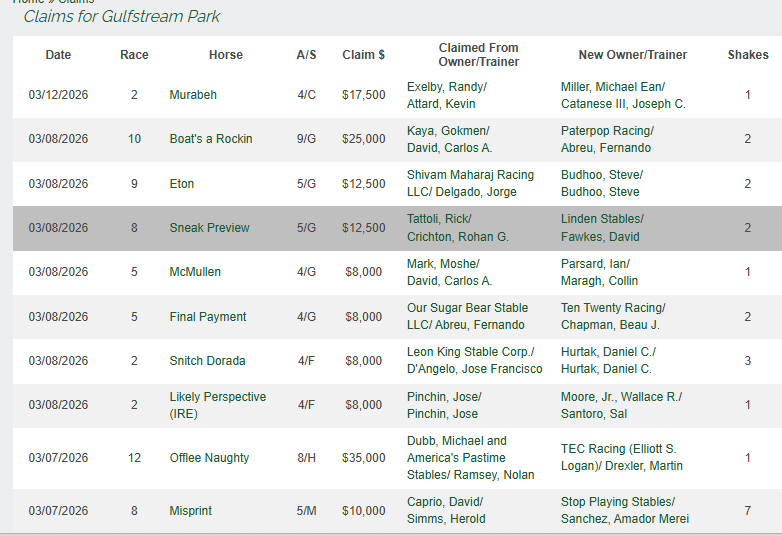
- The Signal: If you see a number like 3, 5, or 10, that is your “Shake Horse.” If it says 1, there was only one buyer and no draw was necessary.
Example Public Links (Current Data)
Aqueduct : Claims at AQU
Gulfstream Park : Claims at GP
Oaklawn Park : Claims at OP
How to read the “Public Sheet” for Betting
When you open these links, look for the following “Moneyball” triggers:
High Shake Count: Any horse with 4+ shakes is a major signal that the horse is undervalued.
The “Loser” Check: Look at the “Claimed From” trainer. If a top-tier trainer (like Brad Cox or Linda Rice) tried to claim a horse and lost the shake to a smaller barn, the horse still has the “talent” that the big trainer saw.
Next-Out Tracking: Professional bettors take the names of horses with high shake counts and put them into a “Virtual Stable” (available for free on Equibase) so they get an email alert the next time that horse is entered to run.
Note: If you are looking for “The Sheets” (capitalized), such as Ragozin or Thoro-Graph, those are proprietary speed figures and are not free. However, the raw data on shaking is public record because it involves the transfer of ownership at a state-licensed facility.
Sample Shake Sheet
The Value Multiplier: Probabilities vs. Price
The beauty of the “Shake Horse” is that the public often misses the upgrade. If I find a horse with a 32% win probability (like a 5-way shake or a major trainer upgrade) but the public lets them go at 4-1 ($10.00), I’m not just gambling—I’m exploiting a massive overlay.
The Favorite: 35% Win Rate at 6/5 Odds = Negative ROI
The Shake Combo: 35% Win Rate at 4/1 Odds = +125% ROI
By combining the variables I’ve identified—from equipment changes to “state-bred drops”—you can find runners with a 40% win probability that the betting board treats like a 20% longshot. That gap is where I build a professional bankroll.
My Top 5 “Shake” Power Combos
When I see these factors overlap, I know the win probability is compounding:
The “Aggressive Intent” (Prob: 38-42%): 3+ Trainers in the shake + Move to a Top 3 Jockey + Running back within 15 days.
The “Barn Upgrade” (Prob: 32-38%): Moving from a <10% win-rate trainer to a >20% specialist + First-time Lasix.
The “State-Bred Drop” (Prob: 45%+): Any shake + Moving from an “Open” race to a “State-Restricted” race.
The “Equipment Fix” (Prob: 30-35%): 3+ Way shake + Addition of Blinkers or a Tongue Tie.
The “Second-Time Charm” (Prob: 28-30%): The horse’s second start for the new trainer after a solid “educational” first run.
Bob’s “Moneyball” Secret: The 48-Hour Shake Routine
I think the best idea we’ve discussed is what I call “The 48-Hour Virtual Scout.” It’s the simplest way to build a high-ROI portfolio without spending all day at the track.
The 2-Day Cycle: Every 48 hours, I check the Equibase Claims Report. I look for any horse with a “Shake” count of 3 or higher.
The “Virtual Stable” Hack: I don’t just memorize the names; I add them immediately to a Virtual Stable.
The Automated Edge: Now, I don’t have to go looking for the horses; they come to me. I get an automated email alert the second that horse is entered in a new race.
Why this works: Most bettors have “goldfish memories.” They forget a Tuesday claim by the time the horse runs on a Saturday three weeks later. By using the Virtual Stable, I’m building a private list of “Expert Approved” runners.
Stop chasing favorites. Start building your stable. Check the shakes, set the alerts, and let the professionals do the scouting for you!
Related Reading: Our Cornerstone Guides
Ready to master the game? Dive into my three most critical deep-dives:
- Mastering Pace Analysis: E1, E2 Figures & Race Shape Understand the heartbeat of the race. Learn how to use E1 and E2 figures to predict which horses will crumble and which will soar.
- The Definitive Guide to Speed Figure Analysis Stop guessing at how fast a horse really is. Learn how to interpret figures to find hidden speed that the public misses.
- Class Ratings: Identifying the Quality Edge The “Secret Sauce” of handicapping. Learn how to spot horses dropping into winning spots and those stepping up to greatness.
Related Questions About The Shake
In major jurisdictions (like NY, CA, and KY), a claim can be voided if a horse is “vanned off” or fails a post-race vet inspection. This protects the person winning the shake from buying an unsound horse.
No. The original owner keeps all purse earnings from that specific race. The new owner (the shake winner) takes ownership only after the race is over and the horse is back at the barn
Claiming Jail” is a rule that prevents a new owner from immediately moving the horse to another track or dropping it into a significantly cheaper race for a set period (usually 20–30 days). This is designed to prevent “horse flipping.
No. To participate in a shake, you must be a licensed owner or have an “open claim” certificate, and the claim must be submitted by a licensed trainer who has funds on deposit in the horsemen’s bookkeeping account.
Yes. A “shake” is a procedural draw for a single race. The “Claiming Crown” is an actual day of championship races (similar to the Breeders’ Cup) specifically for horses that have run in claiming races recently.
Shakes Explained Podcast Transcript
Speaker 1
Imagine you’re looking at just a rusted out $500 junker car.
Speaker 2
Like absolute scrap metal.
Speaker 1
Right. To you, it’s scrap. But what if you suddenly noticed 5 Formula One engineers, you know, creeping over each other, holding open wallets, practically begging to buy it on the spot?
Speaker 2
You would immediately rethink your evaluation of that car.
Speaker 1
Exactly. You’d instantly realize you’re looking at the wrong data. I mean, the surface tells you it’s trash, but the expert behavior tells you it’s a gold mine.
Speaker 2
And that instinct, right, recognizing when the smart money contradicts the obvious data, that is incredibly rare. I mean, most people just stare at historical charts, past performance, or public consensus, and they just assume the past is this perfect map of the future.
Speaker 1
Right, they get stuck on what already happened.
Speaker 2
Exactly. And because of that, they completely miss the silent, real-time signals happening right in front of their faces.
Speaker 1
Well, welcome to our deep dive. Today we are bringing you into a really fascinating, highly secretive money ball economy happening somewhere you might not expect.
Speaker 2
Which is the horse racing track.
Speaker 1
Yeah, the horse track. We’re pulling from this March 2026 article by Bob Shirilla. It’s from the Daily Racing Edge and it’s titled Horse Racing Claiming Shake. how to bet the shake for profit. And look, to be perfectly clear to you listening right now, our mission today is absolutely not to turn you into a gambler.
Speaker 2
No, not at all. You really don’t need to know a single thing about horse racing, or gambling for that matter, to get a massive aha moment out of this.
Speaker 1
Yeah, we’re just using this.
Speaker 2
Right, we are using this ecosystem to extract a brilliant, actionable mental model. It’s all about spotting hidden value when the general public is staring in the completely wrong direction.
Speaker 1
Let’s unpack this. I have to say, looking at the visual backdrop you’ve set up for this deep dive, it sets the mood perfectly. I mean, we’ve got this vintage 1930s racetrack clubhouse aesthetic going on.
Speaker 2
Cigar smoke bedding slips.
Speaker 1
Yeah, but the wood paneling seamlessly blends into this massive wall of like mathematical charts and data plots.
Speaker 2
Well, that visual contrast gets right to the heart of what we’re discussing today. That intersection, the old school grit of the racetrack colliding with cold, hard mathematical Right. That is exactly where this edge lives. This system relies on observing public data that literally everyone on the planet has access to. But, you know, only a tiny fraction of people truly understand how to decode it.
Speaker 1
Okay, so to understand how to find this hidden value, we first have to understand the literal mechanism where that value gets exposed.
Speaker 2
The mechanism of the sport itself.
Speaker 1
Right. In racing, it all revolves around something called a claiming race. and specifically an event known as the shake. So let’s break down the rules of engagement here for everyone. In A claiming race, every single horse running on the track essentially has a price tag stapled to its forehead.
Speaker 2
Literally a set price.
Speaker 1
Yeah, let’s say that price tag is $10,000.
Speaker 2
So prior to the race, any licensed owner or trainer can drop a claim slip into a lock box. And by doing that, they agree to purchase that specific horse for exactly $10,000.
Speaker 1
Before the race even starts.
Speaker 2
Yes. The transaction is finalized before the starting gates even open. So whatever happens in the race, win, lose, or draw the horse, goes home with the new buyer.
Speaker 1
So it’s basically this open market with a fixed price cap, which brings me to the analogy I was thinking about. Imagine you were touring this incredibly average looking house for sale.
Speaker 2
Just a standard suburban house.
Speaker 1
Right. And the sticker price is $300,000. You walk up to the driveway and standing there are five expert structural engineers.
Speaker 2
Okay.
Speaker 1
And they’re all holding briefcases full of cash, all demanding to pay exactly $300,000 for this seemingly average house.
Speaker 2
That tells you something.
Speaker 1
It tells you instantly that the sticker price is wrong. The house is undervalued.
Speaker 2
Exactly. And in racing, when five different professional trainers all decide to drop a claim slip to buy that same $10,000 horse, The racetrack has a dilemma.
Speaker 1
Right, because there’s only one horse.
Speaker 2
Exactly. They have to decide who actually gets it. And they don’t give it to the first person in line or the highest bidder because the price is rigidly fissed by the conditions of the race.
Speaker 1
So what do they do?
Speaker 2
Instead, officials place numbered pills representing each buyer into a small bottle or a container, and they literally shake it to draw a winner blind.
Speaker 1
And that physical act is the shake.
Speaker 2
That’s the shake. The winner just gets the horse.
Speaker 1
A literal shake. That is so funny. But the physical transfer of the horse is really just the beginning of the story, right?
Speaker 2
Absolutely.
Speaker 1
Because why this matters to us and to you listening is what this event represents to the wider market.
Speaker 2
Right, because when a horse goes through a multi-way shake, it is a massive blinking buy signal.
Speaker 1
Yeah.
Speaker 2
Think about the dynamics at play here. You have an intersection of professional valuation and public oversight. Multiple experts, people whose entire livelihoods depend on evaluating equine talent, are putting their own cold, hard cash on the line simultaneously.
Speaker 1
They’re all agreeing at the same time.
Speaker 2
Right. It proves definitively that the consensus of experts believes the horse is worth far more than its current competition level.
Speaker 1
It’s like the ultimate lie detector test. I mean, they aren’t just giving a hot take on a sports radio show or posting some theory on a message board. Their wallets are open.
Speaker 2
Exactly. Cash is on the barrel.
Speaker 1
So knowing what a shake is, I think the immediate question is whether this actually leads to big payouts. Like do these supposedly cheap horses actually turn into anything or are they just fighting over mediocrity?
Speaker 2
That’s the million dollar question. And the historical proof in Sharilla’s piece is wild. These claiming races, they aren’t basements for bad horses. horses. No, they are testing grounds for hidden champions. The history here basically validates the entire model.
Speaker 1
How far back does this go?
Speaker 2
Well, the claiming system has been a staple of American racing for a century, and it has consistently produced legends. Let’s go back to 1943. There was a trainer named Hersh Jacobs, widely known as the Claiming King. He just thrived on the mechanics of the shake. He saw a horse named Stymie running for a claiming tag of just $1,500. $1,500. Right. He won the stake, took the horse and completely changed its trajectory.
Speaker 1
And Stymie went on to become the Beeples horse, right? And he was the very first horse in history to surpass $900,000 in career earnings.
Speaker 2
Exactly.
Speaker 1
From A $1,500 investment.
Speaker 2
Sure.
Speaker 1
I mean, Jacobs basically used the claiming system to rescue undervalued assets from rivals who were, I guess, mismanaging them.
Speaker 2
That’s exactly what he did. And if you fast forward to 2003, the exact same market inefficiency exists.
Speaker 1
Wow.
Speaker 2
A horse fittingly named Shake You Down, running at Gulfstream Park for a $65,000 tag. A massive multi-way shake happens. Trainer Scott Lick wins the blind draw, and the horse immediately goes on an absolute tear.
Speaker 1
He just dominates.
Speaker 2
Yeah, he wins the grade 2 General George Handicap, competes in the Breeders’ Cup, and banks over $1.4 million.
Speaker 1
That is incredible. And then there’s Lava Man in 2004, right?
Speaker 2
Yes, the greatest claim ever.
Speaker 1
Trainer Doug O’Neill claimed him for $50,000 at Del Mar. And Lava Man went on to become a Hall of Famer, earning over $5.2 million.
Speaker 2
It’s absurd.
Speaker 1
To this day, he remains the only horse to win a grade one race on dirt, turf, and synthetic surfaces, all from a $50,000 claim.
Speaker 2
Yep.
Speaker 1
But wait, I have to push back on this premise for a second.
Speaker 2
Sure.
Speaker 1
If Lava Man and Shake You Down were essentially $1,000,000 lottery tickets, just hiding in plain sight with a cheap price tag, why does the general betting public completely miss them? I mean, what on earth are regular people looking at instead?
Speaker 2
Well, what’s fascinating here is the psychology of the crowd. The betting public is obsessed with past performances and speed figures.
Speaker 1
Right, the history.
Speaker 2
Exactly. They stare at what the horse did last month or last year, and they let that dictate their entire worldview. But all of that historical data is already baked into the price.
Speaker 1
Because everyone can see it.
Speaker 2
Right. By focusing solely on the past, the public entirely misses the live, real-time consensus of the professionals. The public sees a horse that historically struggles. The trainers see a physical asset whose previous trainer had them on the wrong diet, or running the wrong distance, or dealing with a minor fixable hoof issue.
Speaker 1
Which brings up a really confusing part of the source material. Sharilla talks about a horse named Charismatic from 1999.
Speaker 2
Yes, Charismatic.
Speaker 1
Yeah, so legendary trainer D. Wayne Lucas runs Charismatic in a $62,500 claiming race. and nobody claimed him.
Speaker 2
Not a single claim.
Speaker 1
Right. Trainers looked to them and collectively passed. There was no shake. And then Charismatic goes on to win the Kentucky Derby and the Preakness Stakes.
Speaker 2
Yeah, it’s a crazy story.
Speaker 1
But the article frames this as the ultimate warning story. If Charismatic won the Derby, wouldn’t that mean that professionals were completely wrong to pass on him? Doesn’t that break the whole smart money is always right theory?
Speaker 2
I get why you’d think that. It seems like a paradox on the surface. But Charismatic is really the exception that proves the rule.
Speaker 1
How so?
Speaker 2
Think about it from an expected value standpoint. When a horse with supposedly great pass numbers suddenly drops into a cheap claiming race 99 times out of 100, The previous trainer knows the horse has a hidden physical flaw.
Speaker 1
Like an injury.
Speaker 2
Yeah, like a ticking time bomb in an ankle or a knee. The professionals know it’s a trap, so they refuse to claim the horse.
Speaker 1
Oh, right.
Speaker 2
Charismatic was that one in a million outlier where the horse was actually healthy and just needed to mature. The public remembers the lottery ticket. They remember Charismatic, which keeps them stubbornly betting on bad horses dropping in class.
Speaker 1
Oh, so they chase the ghost?
Speaker 2
Exactly. This smart money willingly misses out on one charismatic to avoid the 99% of other unclaimed horses that actually are terrible investments.
Speaker 1
Wow. Okay. So the public loses their shirt chasing the rare anomaly. while the pros build wealth by avoiding the traps.
Speaker 2
Not on.
Speaker 1
If there’s no shake on a horse dropping in class, the silence of the professionals is basically screaming at you to stay away.
Speaker 2
The absence of a signal is just as important as the signal itself. And this is where we need to dive into the mathematical reality of this entire system.
Speaker 1
Let’s do it.
Speaker 2
Because the contrast between what the public bets on and what the smart money gets on is stark. Let’s look at the trap of the favorite. Across North American racing, the betting favorite wins roughly 33 to 35% of the time.
Speaker 1
Okay, winning one out of three times feels like a pretty safe strategy. I mean, if I’m hitting 33% of the time, I’m feeling pretty smart.
Speaker 2
Right. Psychologically, it feels great. But mathematically, it is a disaster.
Speaker 1
Really.
Speaker 2
Yeah. Because the public blindly hammers the favorite, the odds get completely crushed. If you bet the favorite every single time, you will suffer a long-term negative return on investment of minus 10 to minus 15%.
Speaker 1
Wow. So you’re losing money even though you’re winning races?
Speaker 2
Exactly. You are essentially paying a heavy tax for the psychological comfort of being right one out of three times. You win more often, but you slowly go broke.
Speaker 1
This is where the Source’s ROI calculator completely changed my perspective on value. It’s eye-opening. We’re looking for the value gap, or what gamblers call an overlay. Let’s define that really quickly for you listening. An overlay is simply a situation where the odds being offered by the betting pool are higher than the actual mathematical probability of that event occurring.
Speaker 2
Right. They’re getting paid more than you should.
Speaker 1
Exactly. So let’s say you use these shake signals to find a horse with a 40% probability of winning. Because the public is ignoring the shake and just looking at an ugly past performance chart, the odds sit at 3 to 1.
Speaker 2
Which means A $2 bet pays $8. Right.
Speaker 1
Over time, taking that specific bet yield a massive positive 60% expected profit margin.
Speaker 2
You are exploiting the gap between public perception and professional reality. The public treats a horse with a 40% win probability like it’s a 20% long shot.
Speaker 1
And that margin is where bankrolls are built.
Speaker 2
Exactly. And Bob Sharilla outlines specific power combos where the pros compound these win probabilities. These are the specific recipes they look for. Take the conviction play, which historically gives you a 38 to 42 percent win probability.
Speaker 1
That’s huge.
Speaker 2
It is. The formula requires a horse to go through a five-way shake, get claimed by an elite trainer, and be entered to run again within 15 days.
Speaker 1
The logic there is so aggressive. I mean, if five pros fought for it and the winning trainer immediately puts the horse right back on the track in two weeks, It signals the horse is in absolute peak condition right now.
Speaker 2
Exactly. There’s no time needed for rehabilitation. The trainer wants to cash in while the iron is hot.
Speaker 1
What’s the next combo?
Speaker 2
Then there’s the secret weapon upgrade, which hits 30 to 35 percent of the time. This involves A three-way shake, plus the horse receives Lasix, which is a very common legal race day medication used to prevent respiratory bleeding for the very first time, plus a switch to a top three jockey in the colony.
Speaker 1
Okay, so the shake proves the raw talent is inherently there. The medication fixes a physical limitation the old trainer couldn’t manage. And hiring an elite, expensive jockey proves the new barn is essentially betting on themselves. They aren’t experimenting. They are going all in for the win.
Speaker 2
And perhaps the most potent combination is the class drop vacuum.
Speaker 1
Oh, this one was interesting.
Speaker 2
Yeah, it hits over 45% of the time. That occurs when any shake horse moves from an open-claiming race, where they have to face literally anyone, into a state-bred restricted race, where they only face horses born in their specific state.
Speaker 1
So you’re taking a horse whose talent was just validated by the brutal open market and dropping them into a protected, artificially slower pond.
Speaker 2
Exactly. It’s a massive structural advantage.
Speaker 1
So stepping back and looking at these combos, it sounds to me like we aren’t betting on the animal at all.
Speaker 2
Not really.
Speaker 1
We are literally just betting on the math, the market inefficiency, and the conviction of the trainer’s wallets.
Speaker 2
That’s the beauty of it. In this money ball system, you completely detach yourself from the emotion of who you things should win the race or what the animal looks like or what its name is. You only care about who is mispriced.
Speaker 1
Right. But once you have that mathematical edge of knowing a shake occurred, the source outlines how to filter out the false positives. Because obviously not every claimed horse works out.
Speaker 2
Right. Trainers make mistakes too.
Speaker 1
Yeah. So Sharilla lists 10 hidden indicators. these subtle post-shake tells that validate the math.
Speaker 2
These are fascinating because they require really keen observation. For instance, the equipment scrub. You look at the horse in the paddock before its next race, and you see the new trainer has removed its front leg bandages.
Speaker 1
Which seems like a totally trivial detail, but it’s actually a huge tell. It signals the new trainer has examined the horse and realizes its legs are sounder and healthier than the previous trainer thought.
Speaker 2
Exactly. They are removing the protective gear because it’s no longer necessary. necessary.
Speaker 1
Wow.
Speaker 2
Or consider the clean feed bloom.
Speaker 1
What is that?
Speaker 2
It’s when a horse’s coat goes from dull and flat under the old trainer to shiny and dappled under the new one.
Speaker 1
Oh, interesting.
Speaker 2
Yeah, it’s a pure biological indicator that the new barn’s superior nutritional program has finally clicked and the animal is thriving.
Speaker 1
And it extends beyond physical tells into strategic ones, right? Like identifying the barn first off specialist, knowing that trainers like Jamie Ness or Linda Rice have historically high win rates, sometimes over 30%, specifically in the very first start after they claim a horse.
Speaker 2
Right, because they have a specific system for upgrading new arrivals.
Speaker 1
Or the owner ego move. If a massive billionaire-backed super stable like Godolphin claims a cheap horse and actually keeps it in their barn rather than selling it, means they see elite high-level potential. I mean, billionaires don’t hoard cheap horses just to have them.
Speaker 2
No, they definitely don’t. But equally important, Sharilla outlines the red flags. You must know when to avoid a shake horse because the context of the claim really matters.
Speaker 1
Like what?
Speaker 2
If the horse has been away from the track for more than 90 days after the claim, that suggests the new trainer got the horse back to the barn and found a hidden injury that required time off.
Speaker 1
So the initial value is just gone.
Speaker 2
Exactly. Or if the horse moves to a trainer who is on an icy cold streak going zero for their last 25 races.
Speaker 1
Yeah, that’s not good.
Speaker 2
Or an absurd class jump. Someone claims a horse for 10,000 and immediately enters it in a $50,000 race. That’s usually just a desperate trainer fishing for luck, not making a calculated mathematical move.
Speaker 1
Now, I have to stop here, because this is making my head spin.
Speaker 2
Uh-oh.
Speaker 1
No, I’m just putting myself in the shoes of our listener. This is a brilliant system, but it sounds completely, utterly exhausting. Are you telling me that to utilize this edge, regular people are expected to sit at the racetrack with a clipboard, seven days a week, tracking whether a horse is wearing bandages or squinting with binoculars to see if its coat is dappled, just hoping to stumble across a five-way shake.
Speaker 2
Who has the time for that?
Speaker 1
Right, who has the time for that?
Speaker 2
Well, that would be a miserable existence. And thankfully, you don’t need a clipboard, and you don’t need to be within 100 miles of a racetrack.
Speaker 1
Oh, thank God.
Speaker 2
Because claiming a horse involves the legal transfer of ownership at a state-licensed facility, every single detail has to be documented. It is all public record.
Speaker 1
Okay, so how do we actually access this without going?
Speaker 2
Bob Shirilla outlines an exact time-saving blueprint for executing this strategy right from your couch. It revolves entirely around the Equibase claims report. It’s a completely free digital tool. It covers all the major tracks, Aqueduct, Santa Anita, Gulf Stream.
Speaker 1
So if I’m looking at this digital report, I assume I’m just ignoring the horse’s name, ignoring its history, and just scanning straight for that shake column.
Speaker 2
That is exactly what you do. You bring up the date and the track, look at the column on the far right labeled shakes, and scroll down looking for a number like 3, 5, or 10.
Speaker 1
Just looking for the big numbers.
Speaker 2
Right. That digit tells you precisely how many trainers submitted a claim slip. If it says one, there was no draw. The horse was claimed uncontested, but if it’s a high number, You found your target.
Speaker 1
He also mentions this great little detail he calls the loser check.
Speaker 2
Oh, I love the loser check.
Speaker 1
Yeah. If you look at the report and see an elite top tier trainer like Brad Cox tried to claim a horse, but lost the blind shake draw to a smaller unknown barn.
Speaker 2
The horse still has the talent.
Speaker 1
Exactly. That horse still possesses the raw talent that the elite trainer spotted. The unknown trainer just got lucky in the draw. but the underlying value of the animal remains the same.
Speaker 2
And to automate this entire process, Sharilla uses what he calls a 48-hour virtual scout routine.
Speaker 1
How does that work?
Speaker 2
Every 2 days, he spends maybe 5 minutes checking the free report for horses with three or more shakes.
Speaker 1
Here’s where it gets so smart. Once he finds those names, he doesn’t try to memorize them or write them on a whiteboard. He adds them to a free virtual stable on the Equibase website.
Speaker 2
Right. It’s essentially an automated tracker.
Speaker 1
So the next time that’s. When a specific horse is entered into a race, whether it’s two weeks or two months later, he gets an automated e-mail alert. It’s like setting up a Google alert for whenever Warren Buffett buys a stock, except you get to buy the exact same stock at the exact same price Buffett did weeks later.
Speaker 2
Well, not quite the exact same stock you aren’t buying the horse itself. You’re getting the chance to place a bet alongside Buffett’s insider knowledge at odds the public hasn’t ruined yet. You are leveraging A derivative of their conviction.
Speaker 1
Right, that makes sense.
Speaker 2
And the psychology behind why this virtual scout routine works so well is due to what Sharilla calls goldfish memory.
Speaker 1
Goldfish memory.
Speaker 2
Yeah, most bettors have terrible memories. They might notice a massive 10-way claim on a random Tuesday afternoon, but by the time that horse actually runs in a race three weeks later on a crowded, chaotic Saturday, the crowd has completely forgotten the Tuesday transaction.
Speaker 1
Because there’s so much noise.
Speaker 2
Exactly. They revert to their comfort zone, staring at the past performance charts. By automating the alerts, you are letting the professionals do all the intense scouting for you, and the digital system just taps you on the shoulder when it’s time to act.
Speaker 1
It’s just brilliant. So to summarize the core lesson for you today, in a world and a market that is completely overwhelmed by noise, by historical data, and by crowd mentality, the true Moneyball edge doesn’t come from being better at reading the same charts as everyone else.
Speaker 2
No, it really doesn’t.
Speaker 1
It comes from ignoring the favorites entirely. The edge is found by following the silent, verified signals of experts who are quietly putting their own money on the line.
Speaker 2
Because the crowd will always pay a heavy premium for comfort, and for obvious historical data, the actual profit is always found in the value gap.
Speaker 1
So the next time you see 5 master mechanics fighting over a dusty 10-year-old sedan, Don’t look at the sticker price. Look at the mechanics.
Speaker 2
Which raises an important question for you to explore in your own life in whatever field you operate in. The Equibase report provides a free public ledger of professional conviction. What other industries, markets, or workplaces have a public sheet of expert behavior hiding in plain sight, just waiting for you to set up the alert?