Handicapper – Guide to Ground Loss and Track Bias
Toll of Wide Trips – Physical and Mathematical
In the racing world, most fans focus on the “what”—the finishing position. But the “how”—the journey or “trip”—is where the professional money is made.
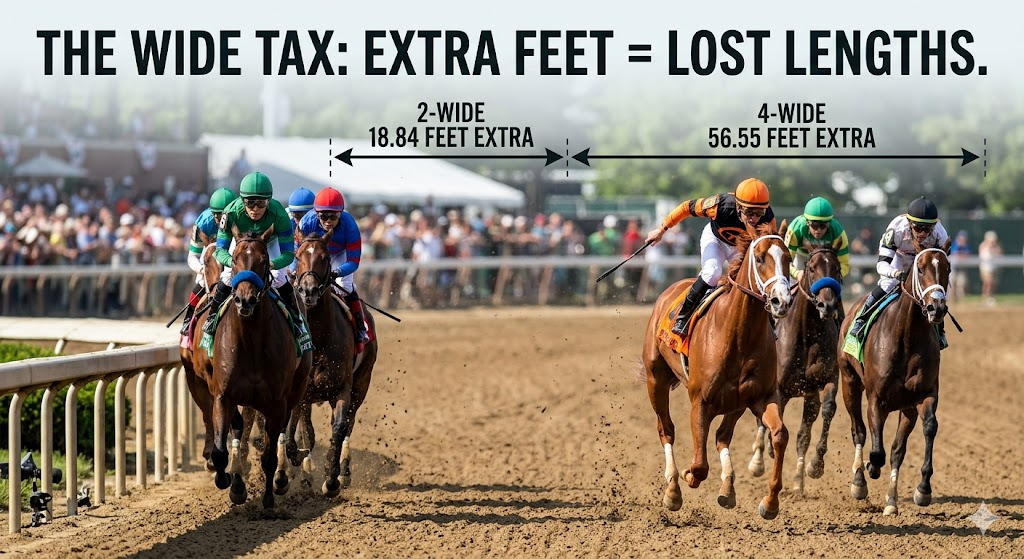
When a horse is forced wide, they aren’t just facing a tactical disadvantage; they are fighting the laws of physics.
The Geometry of “Losing the Turn”
The shortest path on any oval track is the rail. The mathematical certainty of geometry dictates that every “path” outside that line adds incremental distance that can fundamentally change the outcome of a race.
The “One Path, One Length” Rule: As a rule of thumb, every lane (or “path”) a horse travels outside the rail costs them roughly one full length.
The 2-Wide Tax: In a typical two-turn route, staying in the 2-path adds approximately 18.84 feet of extra ground. That’s over 2 lengths given away just for “clear air”.
The 4-Wide Disaster: A horse caught 4-wide around both turns covers roughly 56.55 extra feet. That is nearly 7 lengths of invisible distance the horse had to overcome.
Biomechanics: Why Wide Trips “Burn the Oil”
It isn’t just about the extra feet; it’s about metabolic efficiency. A horse caught wide is “burning its candle at both ends”.
Maximal Propulsive Force: Scientific models show that a horse cannot exert its full engine strength while navigating a turn because track curvature acts as a physical constraint.
The Anaerobic Wall: Moving wide often requires a jockey to “urge” the horse to maintain position against rivals on the rail. This extra exertion pushes the horse into a higher state of anaerobic deficit earlier in the race, leading to a late-race collapse the public mistakes for “quitting”.
Case Study: Spotting the “Heroic Loser”
To find these overlays, you have to decode the chart caller’s shorthand in the Past Performances (PPs).
Example A: The “5w” Heartbreaker
Look at this 2nd-place finish (2no). The horse was bothered at the break (Bothr brk) and was forced to swing 5w

The Story: This horse gave away roughly 4.4 lengths of geometric tax. Since it only lost by a nose, it was objectively the best horse in the race. This is a “Probably Best” performance that the betting public will overlook because the horse didn’t visit the winner’s circle.
Example B: The “4-5w” Form Reversal
This sequence proves that a wide loss is often the setup for a blowout win.
The Setup: In the bottom race, the horse was trapped 4-5w and “missed” the win.

The Payoff: In the next two starts, with more efficient trips (2-3w and 3p), the horse conserved enough “oil” to win by $2\frac{1}{2}$ and $7\frac{1}{2}$ lengths respectively.
The Professional’s Checklist
The ultimate goal is to identify value where the public sees failure. A 2014 study found that betting horses that covered 40+ feet more than the winner (while finishing within 4 lengths) yielded a massive 29% win rate and a positive ROI of $2.90 for every $2.00 wagered.
How to bet:
- Scan the Comment Line: Look for notations like 3w, 4w, 5w, or “Parked out”.
- Verify the Effort: Did the horse finish within 4 lengths of the lead despite the wide trip?
Check the New Draw: Is the horse moving from an outside post to an inside post where they can finally “save ground”?
Bias X-Factor—When “Ground Saved” is “Value Lost”
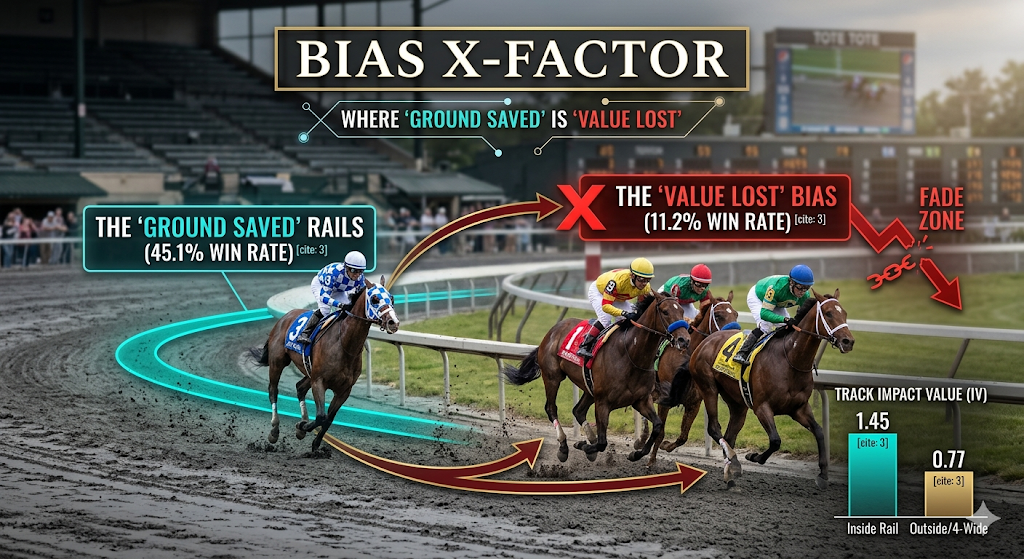
Track bias is a powerful variable that can turn a mathematical penalty into a winning advantage. Bias isn’t just a fast surface; it’s a condition that alters the “cost” of the ground traveled. We must distinguish between True Ground Loss and False Ground Loss.
The Anatomy of Bias: Gold Rail vs. Dead Rail
The surface of a racetrack is rarely uniform. Weather, maintenance, and soil composition create distinct “lanes” with vastly different speeds. The key to exploiting this is classifying the surface on a given day.
| Surface Condition | The “Cost” of Wide Trips | The Handicapper’s Play |
| Gold Rail | Double Penalty. The inside is lightning-fast. A wide horse is penalized by extra distance and slower footing. | Fade Wide Trips. Horses caught wide on a Gold Rail day had zero chance. Do not upgrade them next out. |
| Dead Rail | False Penalty. The inside path is deep, wet, or slow—a literal quagmire. The outside “freeway” offers superior, faster footing. | Upgrade Wide Trips. A horse that looks like a “heroic wide loser” (e.g., 3w or 4w) may have actually been on the fastest part of the track. |
| Fair Track | True Penalty. The math from the first part applies. All paths are equal speed. | Bet the Math. This is the “sweet spot” for using the quantifiable “heroic loser” data for profit. |
Spotting the “Dead Rail” in the Form
A “Dead Rail” is one of the most potent, yet frequently overlooked, factors in handicapping. Because it can be temporary, the public often misses the massive “form reversal” that occurs when a horse moves from a Dead Rail environment to a Fair Track.
Case Study: The Masked “Heroic Winner”
A standard past performance will not state “Dead Rail”; you must infer it.
Consider this sequence in a horse’s past performances:
Race 1: The horse finishes 6th, beaten by 8 lengths. Chart note: “Ins-2p; weakened” (Inside to 2nd path; weakened).
The Analysis: If you know that track had a severe Dead Rail that day, this horse didn’t just “weaken.” They spent the entire race in the equivalent of deep mud, “burning their oil” just to stay in contention.
The Bet: When this horse draws an outside post on a Fair Track in its next start (perhaps “4w; rallied”), the public will bet them down. However, they are likely a significant overlay, set for a dominant performance now that they aren’t fighting the surface.
Professional Bettor’s Checklist: A horse moving from a “saving ground” trip (ins, 2p) on a Dead Rail day to any kind of outside trip (3w, 4w) on a Fair Track is a top-tier candidate for a blowout win.
Conclusion: Bet the Journey, Not the Result
While the casual betting public is often blinded by the final finishing position, the professional handicapper understands that the true value lies in the “trip.” By quantifying the mathematical and physical toll of ground loss, you move beyond guesswork and into the realm of high-probability overlays. Remember: the public bets on the result, but “The Edge” is found by betting on the journey.
Ground Loss Handicapping Examples
Traveling 3-wide (two paths off the fence) on a standard two-turn route adds roughly 37–40 extra feet. At 8–9 feet per length, that horse spotted the field 4.5 to 5 lengths just in geometric
Horse B got the “dream trip” and still couldn’t get it done. Horse A ran a much faster “raw” race but was taxed by the 5-wide path. The public will hammer B because he’s “knocking on the door,” while Horse A will offer a price despite being the superior physical performer.
A Gold Rail is a double whammy: the horse loses ground by going wide and stays on the slower part of the track. Even a “best” horse will struggle to overcome the physics of a biased surface. Save your money for a Fair Track.
It’s about metabolic efficiency. Fighting centrifugal force on the first turn of a route “burns the oil” in the anaerobic tank early. By the time they hit the far turn, they’ve already over-extended. The public sees them “empty out” at the 1/8th pole and calls them a “quitter,” but the trip is what actually killed them.
A “Dead Rail” means the inside is a quagmire. A horse that wins there usually has to exert massive energy just to overcome the slow footing. This often leads to a “bounce” (regression) in their next start because they haven’t recovered from the internal toll of fighting the bias.