
This isn’t just about a race at Turfway Park; it’s about the soul of handicapping. It’s about that moment on a Wednesday night when the world goes quiet, the house is still, and it’s just you, a lukewarm cup of coffee, and a $17,000 carryover calling your name from the bottom of a 10th-race maiden claimer.
The Wednesday Night Wrestling Match at Turfway Park
I’ve been staring at Race 10 at Turfway Park for so long my coffee went cold, got reheated, and went cold again. On paper, it’s nothing to write home about. It’s a 6½-furlong maiden claiming race for fillies and mares on the Tapeta. There are no graded stakes stars here, no million-dollar pedigrees parading in the paddock, and no Triple Crown dreams.
But for an old handicapper like me, a $17,000 carryover is the ultimate siren song. It turns a mundane mid-week card into a three-hour tactical war with the Daily Racing Form. I’ve scoured every metric: race ratings, class drops, pace projections, and speed figures. I even found myself holding court in a digital grandstand, debating the form with Gemini, ChatGPT, and Claude. I treat them like three young, brilliant assistants who have never actually felt a freezing North Kentucky wind cut through them at the Turfway rail.
They gave me their models. They gave me their probabilities. I nodded at their math, and then I went back to the trip notes. Because that’s where the truth usually hides.
The Race on Paper vs. The Race in Reality
On the surface, the “Paper Race” is elementary. If you’re a “Beyer Believer”—the type of player who treats a speed figure like it was handed down on stone tablets from Mount Sinai—you probably already have your tickets printed.
Tier 1: The Speed Leaders
- Taqdeer (#5): She is the logical, towering favorite. She’s paired 58 Beyers in her last two starts, showing the kind of consistency that’s a rare commodity at this level. She fits the $30,000 claiming tag like a glove and simply runs her race every time the gate opens.
- Click Here (#11): She owns the biggest “back figure” in the race—a 66 earned two starts ago. If she finds that gear again, she wins. But she’s cutting back sharply in distance, and that’s a transition that often leaves a horse flat-footed when the real sprinting begins.
- Cuvee Creed (#7): She’s the definition of an “honest” horse. With recent mid-50s and blinkers going on today, she’s the horse the public will use to fill out their exactas.
- Givemethebeat (#10): She owns the sharpest early pace numbers in the field and gets a massive seven-pound weight break. If she clears the field early, she’s going to get very brave.
But racing isn’t always about who ran the fastest number last month. Sometimes, it’s about the horse that is sitting on a massive, invisible improvement.
Pace Makes the Race: The Tapeta Sprint
Six and a half furlongs at Turfway is a deceptive distance. It’s a graveyard for pure “burners” who run out of gas at the six-furlong pole, yet it’s often too short for the “grinders” who need a mile to find their stride.
To win here, you need position and balance. You need a horse that can sit within two lengths of the lead at the quarter pole and still have enough “kick” left to handle the synthetic surface’s late-stretch fatigue. While Givemethebeat and Dani Girl will provide the early friction, I don’t see a suicidal pace meltdown. I see honest fractions, which usually favors a stalker like Taqdeer.
And yet, I keep circling back to the #12: Kyler.
Scott Ehlers’ Note and the Hidden Foundation
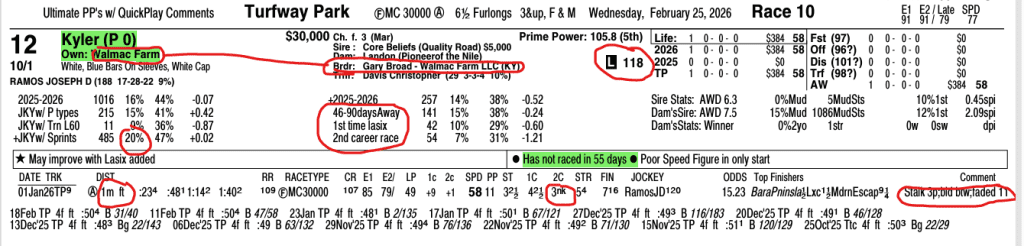
Most bettors will look at Kyler’s debut and see a 28 Beyer—a number so low it looks like a typo. They’ll toss the form and never look back. But I saw the note from Scott Ehlers: Kyler was stuck in the 11-hole in her debut. She made a nice middle move before calling it a day.
That’s not hype; that’s observation. Kyler went a mile in her first career start, was forced three-wide the entire way, and yet she made a legitimate, professional move between horses before the distance (and the lack of experience) caught up to her. The rider didn’t punish her once she was beaten; he let her coast home.
When I see a horse go long in their debut, show tactical ability, and then fade late, I don’t see a 28. I see a foundation.
The Development Curve and the Ownership Angle
Second-time starters, especially three-year-old fillies, are the biggest “X-factors” in horse racing. Kyler is getting:
- Lasix for the first time.
- A cutback from a route to a sprint.
- 56 days to mature.
- Four steady workouts since her debut.
Now, you aren’t asking her to improve 30 points to beat the favorite. You’re asking her to improve 15 points—a move that is common for horses moving from a debut route to a second-start sprint.
Furthermore, look at the owners. The breeder is still the owner. They didn’t dump her at a mid-level auction; they kept her and placed her here. In pure dollars, winning this race and potentially getting claimed for $30,000 exceeds what she might have brought as a modest yearling. This isn’t desperation; it’s placement. They believe she fits.
Logic vs. Instinct: The Final Confession
When I run this race through the AI models, the machines keep putting Taqdeer on top. They love the paired figures and the consistency. When I ask them about Kyler, they hesitate. They tell me she’s “unproven” and “statistically inferior.”
And I tell them: “You didn’t watch her run.” The machines don’t understand the nuance of ground loss or the specific look of “first-start fatigue.” That remains the human edge. At the end of the day, I’m siding with the horse that feels like she’s about to wake up.
$17K Super Hi-5: Why Chaos and Carryovers Rule the Night
Turfway Park’s Super Hi-5 stands out in the wagering world primarily because of its 10-cent minimum, a low entry point that encourages “lottery-style” betting. While the cheap price allows bettors to cover more combinations, the sheer mathematical complexity of the wager, combined with Turfway’s modest pool sizes, means that many possible outcomes remain uncovered. This structural gap, where the number of possible finishing orders often exceeds the number of tickets sold, is the primary engine behind the track’s frequent carryovers.
The difficulty is amplified by Turfway’s specific racing conditions: large fields, unpredictable Tapeta synthetic surfaces, and the tendency to place the wager on the final race of the night. These “nightcaps” often feature lower-level claiming horses and chaotic finishes that defy standard handicapping. To actually trigger a payout and capture a carryover, the math is clear: you generally need a significant longshot to crash the top five. Without a price horse to blow up the chalky combinations, the result is rarely unique enough to sweep the pool, leading to the jackpot-style build-ups the track is known for.
The “10-Cent Carryover” Betting Strategy
You can’t beat a 10-cent combo when there is $17K on the line. I’m going to be “Longshot Larry” tonight and key Kyler on top of my Super Hi-5.
The Super Hi-5 Ticket
- 1st: #12 (Kyler), #5 (Taqdeer)
- 2nd: #12, #5, #11 (Click Here)
- 3rd: #12, #5, #11, #10, #7
- 4th: #12, #5, #11, #10, #7, #1 (Monsoon Dancer)
- 5th: #12, #5, #11, #10, #7, #1, #4 (Rachel’s Kid)
Because sometimes, after you’ve looked at every spreadsheet and every machine-generated probability, you have to trust the horse that’s ready to show the world the numbers were lying.