Ride the Wave: How “Form Cycles” Can Help You Win at the Track
We’ve all been there. You pick a horse that won its last race by five lengths. It looks like a monster on paper. This horse also has the best speed figures in the field. You put your hard-earned money down. The gates open, and… he finishes dead last.
You’re left scratching your head, wondering what happened. The truth is, horses aren’t machines. They are athletes. Just like a baseball player goes through a hitting slump or a football team gets “tired legs” late in the season, horses go through Form Cycles.
If you can learn to spot these cycles, you’ll stop betting on horses that are about to “bounce” (run poorly). Then you can start finding the ones ready to explode at a big price.
What is a Form Cycle?
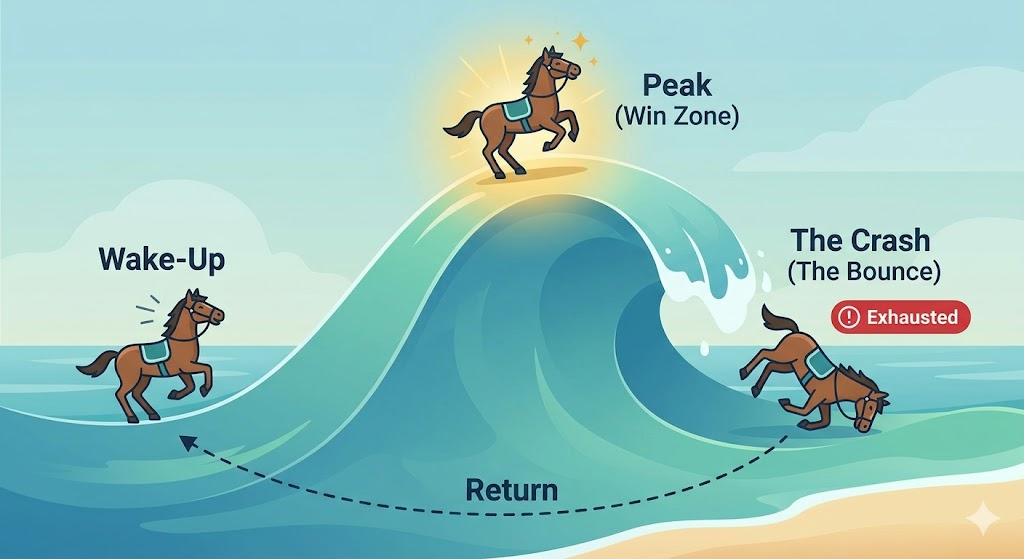
Think of a horse’s fitness like a wave in the ocean. It starts small, builds up to a big peak, and eventually crashes back down. A form cycle is simply the “up and down” journey of a horse’s physical readiness during a racing season.
Most horses follow a predictable pattern:
The Wake-Up (Improvement): They are getting fit and getting faster.
The Peak (The Win Zone): They are at their absolute best.
The Crash (The Bounce): They gave too much last time and are now exhausted.
Step 1: Find the Cycle (Look at the “Layoff”)
The cycle almost always starts after a layoff (a break from racing). When a horse has been away for 60 to 180 days, they are “fresh” but usually not “fit.”
The First Start Back: Think of this as a “tightener.” The horse is stretching its legs and getting its lungs back. Unless the trainer is a specialist at winning off the bench, this horse is usually just starting its cycle.
The Second and Third Starts: This is where the magic happens. By the third race after a break, the horse’s heart and lungs are usually in sync. This is the “Sweet Spot” where they are most likely to run a career-best race.
Step 2: Evaluate the Cycle (Spotting the “Bounce”)
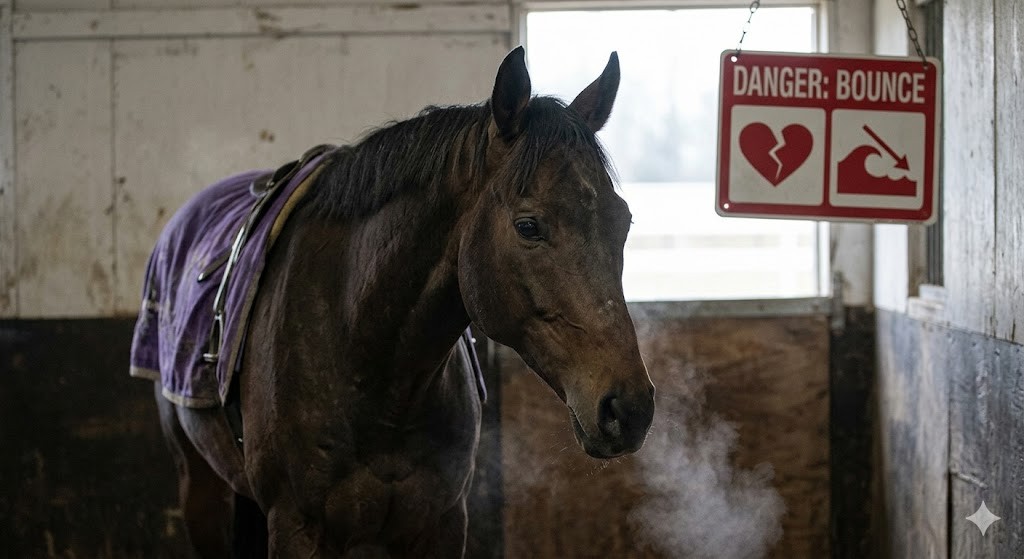
This is the most important lesson for any bettor. A “Bounce” happens when a horse runs a massive, “super-human” race that takes everything out of them.
If you see a horse that just ran the fastest speed figure of its life last time out, be careful. Their body often can’t handle back-to-back peak efforts. The public will bet them heavily because of that last fast race. However, the “Cycle” tells us they are due for a crash. Therefore, betting against these horses is a great way to save money.
Step 3: Use the Cycle as Your “Secret Hedge”
Handicapping isn’t just about who is the fastest; it’s about who is the fastest today. Use the form cycle as a “filter” for your bets:
The “Improving” Bet: Look for a horse that has finished 4th, then 3rd, and has improving speed figures. They are “circling” a win. They are on the upward part of the wave.
The “Freshness” Factor: In lower-level claiming races, horses get tired quickly. If a horse is on its 10th start of the year without a break, they are likely “tailing off.” Look for the “new” horse in the race—someone coming off a 60-day freshening. They have more “battery” left than the others.
The Facility Edge: If you see a horse training at a world-class place like Palm Meadows (PMM), they might be fitter than they look. These tracks have better surfaces and even swimming pools. As a result, this setup helps horses stay in their “Peak Phase” longer without their legs getting sore.
The Bottom Line
Stop looking at just the “1s” and “2s” on the program. Start looking at the direction the horse is moving. Is the wave going up, or is it about to crash?
Once you start betting the cycle instead of just the last race, you’ll start seeing the track in a whole new way. Also, your bankroll will thank you for it.
Final Furlong – Bob Shirilla
When I look at a horse’s past performances, I define a true “cycle reset” by a layoff of at least 60 to 90 days.
In my experience, any break shorter than 60 days is usually just a “freshening”—enough time for a horse to get over a minor illness or a bruised foot, but not long enough for the body to completely lose its competitive edge. When a horse returns within that two-month window, I treat them as if they are still in their previous cycle.
However, once a horse hits that 90-day mark, I consider the old cycle closed. Here is how I break down the timing for a reset:
The 90-Day Rule (The Standard Reset): At this point, the horse has lost its “race fitness.” Their lungs and heart aren’t as sharp as they were, even if they’ve been working out. When they come back, I’m looking for them to start the “Improvement Phase” all over again.
The 180-Day “Hard Reset”: If a horse has been gone for six months or more, the cycle hasn’t just reset—it’s a total mystery. These horses often need one or even two races just to remember how to compete. I am very cautious betting these “long layoffs” to win unless the trainer is a known specialist.
The “Cargo” Reset: I also keep an eye on the calendar when horses move between tracks, like moving from the winter meet at Gulfstream up to the summer at Saratoga. Even if the break is only 45 days, the change in climate and surface can sometimes act as a “soft reset” for the horse’s energy levels.
For me, the goal is to find that third start after a 90-day layoff. That is the “sweet spot” where the reset is complete, the fitness is back, and the horse is usually ready to run a winning race at a price.![A photographic close-up of a dark bay racehorse standing in a stable at twilight, with a hanging wall calendar in the foreground prominently displaying the 90-day mark. Caption: I consider the old cycle closed [at 90 days]. At this point, the horse has lost its "race fitness."](https://dailyracingedge.com/wp-content/uploads/2026/04/racehorse-rest-period-calendar-layoff.jpg)
While the basic stages of a cycle remain the same, I’ve found that the way a horse moves through those stages changes significantly depending on whether they are running on dirt or turf. In my analysis, I treat them as two different types of physical stress.
The biggest difference I see is in the regression phase, specifically the “bounce” risk. Dirt is a concussive surface—it’s hard on a horse’s bones and ligaments. When a horse runs a “new top” speed figure on dirt, the physical toll is massive. On the other hand, turf is much more forgiving. Because the grass acts as a cushion, I find that turf horses can often “pair” high speed figures or maintain their peak phase for three or four races in a row without falling apart.
Here is how I adjust my logic when I’m looking at a turf cycle:
Longer “Sharp” Windows: On dirt, I usually expect a horse to start tailing off after four or five hard efforts. On turf, a “sharp” horse can stay at the top of its game for a much longer stretch of the season because they aren’t taking the same “pounding” every time they leave the gate.
The Weight Factor: Turf racing is often more about a late turn of foot than raw early speed. This means weight and “respiratory strain” matter more. If a horse is at the end of a long turf cycle and the racing secretary adds five pounds to its back, that’s usually when I expect the cycle to finally break.
The “Freshness” Premium: Because turf racing is less physically taxing, I don’t value “freshness” off a layoff quite as much as I do on dirt. A dirt horse coming off a 60-day break is a dangerous weapon; a turf horse often needs that first race back just to get its “wind” (cardiovascular fitness) up to speed for that big finishing kick.
Environmental Disruptors: I pay much closer attention to the weather on turf. A “soft” or “yielding” course can completely exhaust a horse that is supposedly in its peaking phase. If a horse runs a huge race on a boggy turf course, I am much more likely to look for a “bounce” in its next start, even though it’s grass, because the effort required to pull its feet out of the mud is so draining.
In short, I give turf horses more “benefit of the doubt” to stay fit longer, whereas I’m always waiting for the “crash” with a dirt horse that’s been running hard.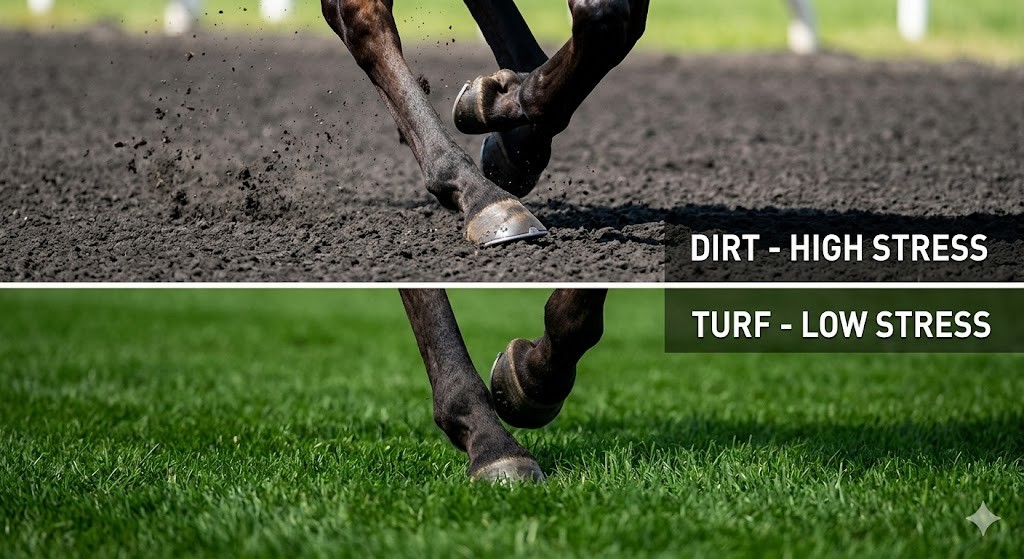
To identify a “Master of the Layoff,” I look past the basic wins and losses and focus on the trainer’s specific intent and the resources they have at their disposal. Identifying these trainers is a huge part of my strategy because they can “short-circuit” the typical form cycle, winning when most horses are still in their “shaking off the rust” phase.
Here is how I spot them:
I Dig Into the 90-Day+ Statistics: Most high-end past performances (like DRF Formulator or Stats Race Lens) provide a specific category for “61+ Days Off” or “90+ Days Off.” I don’t just look for a high win percentage; I look for a high ROI (Return on Investment). A trainer who wins 25% of the time off a layoff but pays $4.20 isn’t as valuable to me as the one who wins 15% of the time but pays $18.00.
I Evaluate Their “Home Base”: This is where the training facility matters most. If I see a trainer stabled at a world-class center like Palm Meadows (PMM) or Fair Hill, I automatically upgrade their layoff runners. These facilities allow trainers to keep a horse “race-fit” without actually racing. They use tools like swimming pools and specialized wood-chip gallops to build lung capacity, meaning the horse arrives at the track already in its Peaking Phase.
I Look for the “Intentional Work” Pattern: I check the workout tab. A “Master” isn’t just galloping a horse to keep it happy; they are mirroring race conditions. I look for a “bullet” workout (the fastest of the day) followed by a long, slow gallop, and then another sharp gate work about 7 to 10 days before the race. This tells me the trainer has specifically tightened the screws for a “win-first-time-out” effort.
I Watch the Class Level: A true master of the layoff rarely “drops” a horse in class unless there is a physical problem. If a trainer brings a horse back after four months and enters them in the same class or even a higher class than they left, it’s a massive signal of confidence. It tells me the horse didn’t have an injury; they just needed a break, and the trainer thinks they are better now than they were before.
I Track the “Second-Start-Off” Regression: Interestingly, some of the best layoff trainers are so good at getting a horse “cranked” for the first race that the horse almost always “bounces” (regresses) in the second start back. If I see a trainer who consistently wins at 30% off the layoff but only 5% in the “second start off,” I know I’ve found a Master who pours everything into that first comeback race.
By identifying these trainers, I can often find “invisible fitness” that the general public misses, allowing me to bet a horse off a long layoff with total confidence.
When I see a horse with a “troubled trip” while they are clearly in an improvement phase, I don’t see a bad performance—I see a massive betting opportunity. In my handicapping, a troubled trip acts like a “mask” that hides the horse’s true form from the general public.
Here is how I process a troubled trip through the lens of the form cycle:
1. The “Hidden” Step Forward
If a horse is in the upward part of its cycle (moving from its 1st start to its 2nd or 3rd off a layoff), its body is screaming to run faster. If that horse gets checked, blocked, or forced to go five-wide on a turn, the final speed figure will look “dull” on paper.
While the public sees a “6th place finish,” I look at the visual energy. If the horse was fighting the rider, weaving for an opening, or galloped out strongly past the winner after the wire, I conclude that the physiological improvement happened even if the result didn’t show it. To me, that horse has still taken its “step forward” in the cycle.
2. Avoiding the “False Bounce”
One of the best things about a troubled trip during an improvement phase is that it actually saves the horse for the next race.
A horse that wins by 5 lengths in a “peak” effort often uses up all its gasoline and “bounces” next time.
A horse that was “loaded” but never got to run because it was trapped behind a wall of horses hasn’t spent its energy.
I treat that horse as if it is “still peaking.” They have all that pent-up fitness ready to be released in the next start, often at much better odds because the public only looks at the finishing position.
3. The “Trainer Intent” Signal
I pay close attention to how the trainer reacts to a troubled trip. If the horse had a rough go at a certain class level and the trainer immediately brings them back at the same level or higher, it’s a huge “go” signal for me. It tells me the trainer knows the horse was ready to win and that the “cycle” is still very much alive.
4. What I Look for in the Next Start
When that horse returns, I’m looking for two things to confirm the cycle is still on track:
A Clean Draw: I want to see them in a post position where they won’t get trapped again.
Aggressive Jockey Change: If a trainer replaces a passive rider with a “money” jockey after a troubled trip, it tells me they aren’t leaving the next race to chance.
In short, I view a troubled trip as a “stored” performance. The horse’s body did the work to get fit, but the circumstances didn’t let them show it. I’ll bet that horse back almost every time, knowing the form cycle is actually more advanced than the “1-2-3” finishes suggest.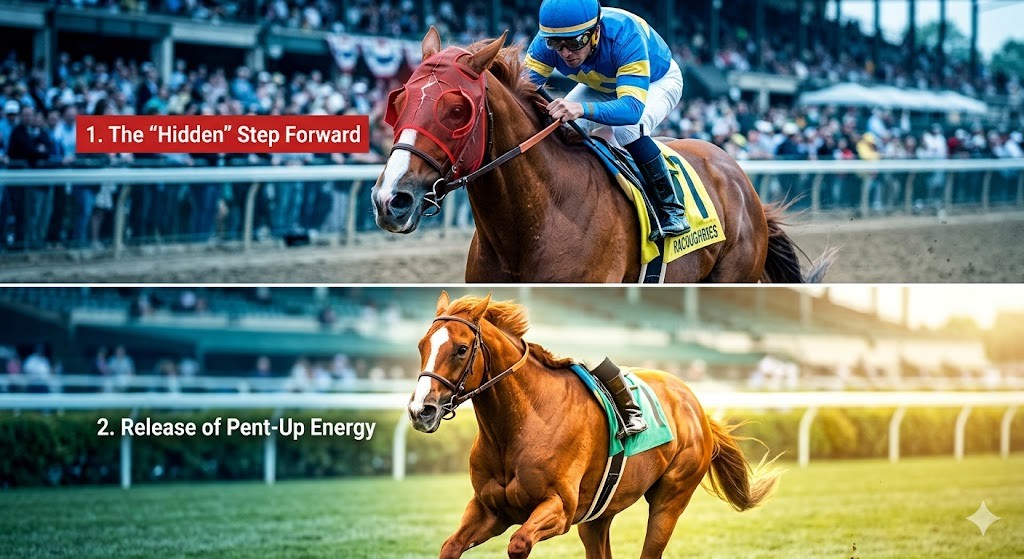
Whether a horse can maintain a “Peak” phase is the most important question for a bettor, and the short answer is No, they cannot stay at that level indefinitely.
In my experience, a horse’s peak is a fragile window, not a permanent state. Here is how I break down the “Peak” phase of the cycle:
The “Rule of Three”
For most Thoroughbreds, the absolute maximum number of true peak races they can run in a single cycle is three.
The 1st Peak: This usually happens in the 3rd or 4th start after a layoff. The horse is finally 100% fit and runs a career-best speed figure.
The “Pairing” Effort: If the horse is high-quality or running on a forgiving surface like turf, they might “pair” that figure, running an identical peak performance in their next start.
The Decline: By the third “peak” attempt, the physiological “battery” is almost always drained. Even if the horse looks “sharp” in the morning, the cellular fatigue from those previous max-effort runs leads to a regression.
Why the Answer is “No” (The Biological Ceiling)
The reason a horse can’t stay at peak form is rooted in their biology. A true peak performance requires the horse to reach its anaerobic threshold—essentially burning fuel faster than their lungs can provide oxygen.
This creates a massive buildup of lactic acid and causes microscopic “tears” in the muscle and bone.
While a human athlete might recover in a week, a 1,200-pound horse carrying 120 pounds at 40 mph takes much longer to heal.
If you try to run them at that peak level a fourth or fifth time without a “freshening” break, the cycle will crash, often resulting in a “bounce” or, worse, an injury.
Exceptions to the Rule
I do see rare exceptions, but they are specific:
Elite “Freaks”: Top-tier Grade 1 horses (the top 1% of the breed) have higher recovery rates and can sometimes sustain a peak for 4 or 5 races.
Turf Specialists: As I’ve mentioned, the grass surface is less “concussive.” I’ve seen turf sprinters stay in a “winning groove” for a full summer meet because the physical toll is lower.
The “Drop in Class”: Sometimes a horse looks like it’s still “peaking,” but it’s actually regressing. If a trainer drops a horse from a $50,000 claimer to a $25,000 claimer, the horse can run a “dull” race for its cycle but still win because the competition is so much slower.
My Betting Hedge: If a horse has already run two “peak” races back-to-back, I almost always bet against them in their third start. The public will hammer them based on those two wins, but the form cycle tells me the “crash” is coming. To me, identifying the end of a peak is just as profitable as finding the beginning.
I find that a horse’s age is one of the most critical factors in determining how a cycle develops and, more importantly, how long it lasts. You have to look at young horses and older veterans through two completely different lenses.
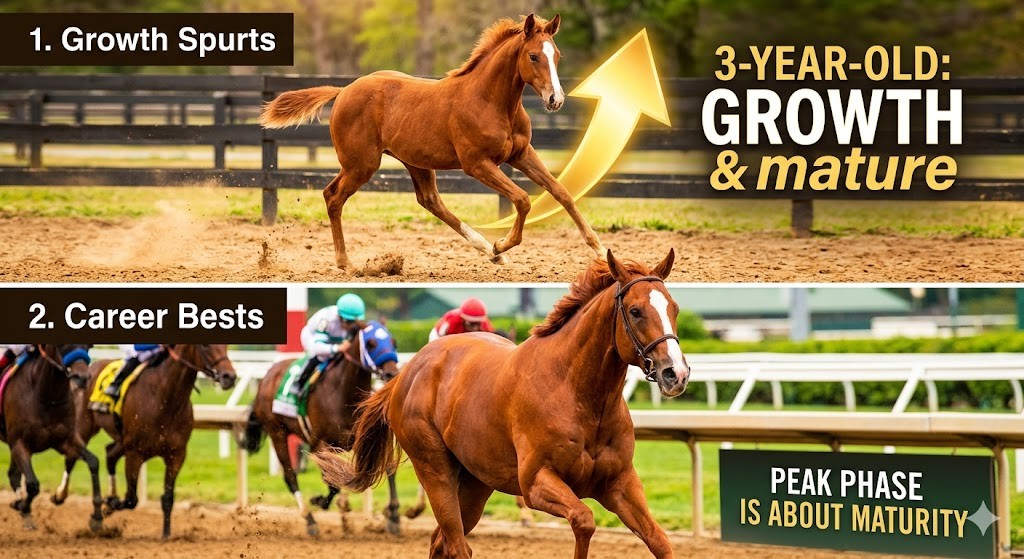
The “Growth” Cycle: 2 and 3-Year-Olds
When I’m handicapping “sophomores” (3-year-olds), I expect the cycle to be much more aggressive and unpredictable.
Constant Improvement: Young horses are still physically growing. Their bones are hardening, and their muscle mass is increasing every month. This means their “Peak Phase” isn’t just about fitness—it’s about maturity.
The “Mega-Jump”: A 3-year-old can run a speed figure in May and then run 10 points faster in July simply because they hit a growth spurt.
Fragility: The downside is that their “crash” can be much more severe. If a young horse is pushed too hard to reach a peak before their skeletal system is ready, they don’t just “bounce”—they often need a “hard reset” (a long layoff) to recover.
The “Maintenance” Cycle: 5-Year-Olds and Up
Once a horse hits age five, the game changes. They are fully developed, so the cycle is no longer about growth; it’s strictly about training and fitness.
Predictable Patterns: Older horses are “what they are.” You won’t see many $20,000 claiming veterans suddenly run a career-best speed figure out of nowhere. Their cycles are very steady. I look for them to “pair” their best figures rather than jump to new heights.
Shorter “Sharp” Windows: An older horse’s body takes longer to recover from a max effort. While a 3-year-old might be able to handle a 2-week turnaround, I find that older horses in their peaking phase need at least 21 to 30 days between starts to keep that cycle alive.
The “Tail-Off” Risk: Older horses are much more likely to hit a permanent “Tail-Off” at the end of a long season. Once a veteran horse’s form starts to dip, it’s very rare for them to “wake up” again without a significant 60-90 day layoff to reset their battery.
The 4-Year-Old “Transition”
The 4-year-old year is the “bridge.” This is often when a horse reaches its absolute physical prime. I love targeting 4-year-olds in their third or fourth start of the year. They have the residual strength of a veteran but still possess some of the “forward-move” potential of a younger horse.
My Betting Rule of Thumb: I’m willing to bet on a young horse to “outrun” its cycle because they are still improving. But with an older horse, I strictly follow the “Rule of Three”—once they’ve run a few big races, I assume the tank is empty and the cycle is over.