
Handicapping the Bounce – Tossing Vulnerable Favorite
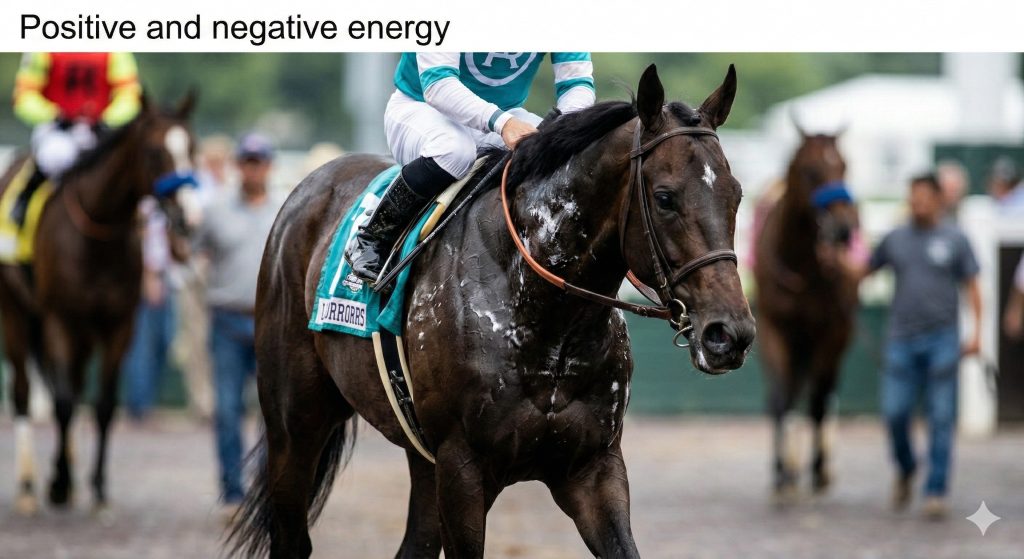
We’ve all been there. You are looking at the past performances for a race at Gulfstream Park or a Tuesday card at Mahoning Valley, and a horse jumps off the page. In their last start, they ran an absolute monster of a race—winning by five lengths and posting a speed figure that crushes the rest of the field.
The betting public hammers them at the windows, sending them to the post as a heavy 4-5 favorite. The gates open, and… they completely fall apart, staggering home an exhausted fourth.
What happened? You just witnessed a “bounce.”
Understanding the bounce theory isn’t just about knowing when a horse might lose; it’s one of the most powerful tools in a handicapper’s arsenal for finding massive value and tearing up the public’s tickets.
The Price of a Peak Performance
At its core, the bounce theory is based on a simple physiological reality: when a horse exerts a maximal, career-best effort, the animal will subsequently experience a severe regression in form. Think of it like a human athlete running a grueling, personal-best marathon; they aren’t going to turn around and run that same time a few weeks later.
Pioneered decades ago by figure-makers like Len Ragozin and Jerry Brown, this concept fundamentally changed how the sharpest minds in the game evaluate horses. It forces us to realize that a horse’s gas tank is not infinite.
Why Do Horses Bounce?
A bounce happens because the horse overexerted its central nervous system and musculature to achieve that massive peak. However, it is crucial to tell the difference between a freak anomaly and natural improvement:
The Maturing Youngster: If a lightly raced three-year-old suddenly posts a massive new top figure, they might not bounce. In young, developing horses, dramatic jumps are often just natural physical maturation and the horse figuring out how to race.
The Old Claimer: If a fully mature, five-year-old claiming horse suddenly jumps 10 points forward out of nowhere, that is a stark anomaly. They have already reached their genetic ceiling, making that effort an exhausting, unsustainable aberration. That horse is primed to collapse.
Spotting the Setup in the PPs
You don’t need a math degree to spot a bounce candidate; you just need to know how to read the form cycle.
Find the Baseline: Look at the horse’s last six to ten starts to find their normal “cruising speed”.
Identify the “New Top”: Look for the freak race. On a Beyer or Equibase scale, this is usually a sudden, unexplained forward jump of 8 to 20 points above their established median.
Beware the Lethal “0-2-X” Pattern: This is the most dangerous form cycle in racing.
0: The horse runs their initial career-best effort.
2: The horse comes right back and runs a figure very close to that new top (digging incredibly deep to pair the peak while exhausted).
X: The third race. The horse’s glycogen reserves are completely empty, resulting in a catastrophic bounce.
Not All Fast Figures Are Equal
A big number on a piece of paper doesn’t guarantee a bounce. You have to ask: How hard did they work for it?
If a horse grabbed an easy, uncontested lead on a speed-biased track with zero pace pressure, the physical exertion might have actually been minimal.
But, if they achieved that massive speed figure by overcoming severe adversity—like racing four paths wide, battling through a grueling pace duel, and grinding it out on a tiring track—the physical toll is exponential. That is your ideal bounce candidate. Always watch the replay of the gallop out past the finish line; if the horse pulls up immediately and looks taxed, a regression is likely coming.
Validating the Bounce at the Track
If you are watching the live feed or standing by the paddock, a horse about to bounce will often tell you before the gates even open. Look for signs of negative energy and residual anxiety:
Washiness: Is the horse sweating excessively and nervously in the post parade?.
The Piston Shuffle: Instead of a calm, fluid walk, is the horse rapidly and forcefully moving its legs up and down with nervous energy?.
Morning Workouts: Ironically, a horse that works out excessively fast in its first timed drill after a peak effort is often showing a false impression of wellness driven by nervous anxiety.
Turning the Theory into Profit
So, how do we make money off this?
Fade the Vulnerable Favorite The general betting public has severe recency bias; they will blindly anchor their money to the highest, most recent speed figure in the program. If you identify that last-out monster figure as a bounce setup, you can confidently bet against them. This is devastatingly profitable in multi-race wagers like the Pick 4 or Pick 5. The public will use the bounce candidate as a “single.” When that favorite finishes off the board, millions of dollars in public tickets go up in smoke, setting up massive payouts for players who spread their bets to value horses.
The “Bounce-Back” Rebound This is the ninja move of handicapping. Wait for a horse to run their massive top, and let the public bet them heavily in the next start. When the horse inevitably suffers their exhaustion-driven bounce and runs a terrible race, the public will abandon them.
In their next start, that ugly running line will inflate their odds to longshot territory. But the sharp player knows that the terrible race was just a much-needed form cycle reset. Assuming they are healthy, the horse is now fully recovered and sitting at a great price.
Putting the Bounce Theory to Work: A Checklist to Spot Vulnerable Favorites
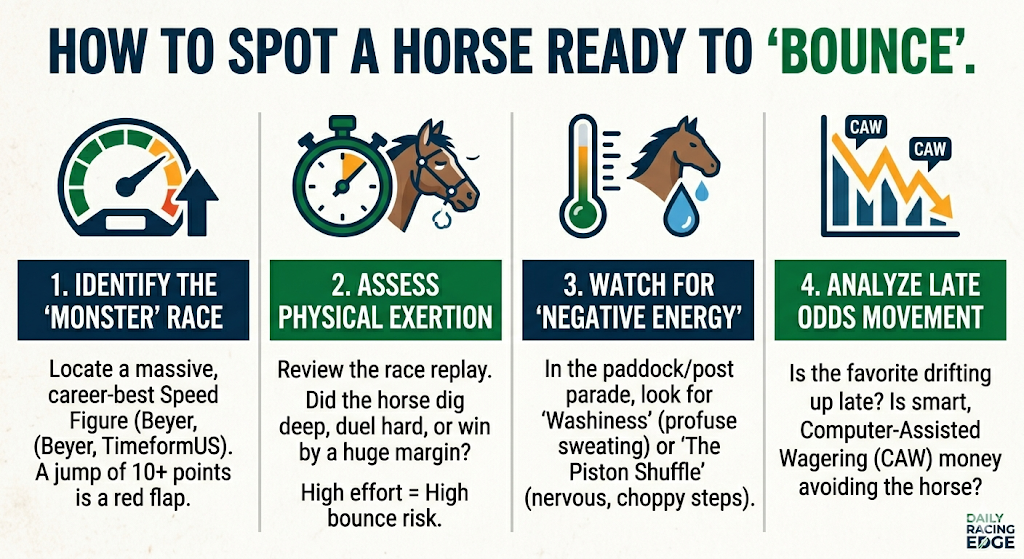
Understanding the bounce theory in horse racing is useless if you don’t know how to apply it during the live racing program. After we have analyzed the horse’s past performances, watched the replay, and reviewed the late odds action, it’s time to put all those clues together into a definitive, actionable checklist. Use this infographic as your final guide to make a confident decision and avoid backing a favorite primed for a severe regression in form.
The Final Furlong
Handicapping is a puzzle, and no single angle works 100% of the time. But the bounce theory provides a critical lens to see what the crowd misses. By establishing a horse’s baseline, identifying the freak exertion, evaluating the trip, and watching their physical cues, you can confidently toss underlaid favorites and find the hidden value that actually builds your bankroll.
Watching the late betting action can give you a huge clue about how a horse is really feeling, and today, that means paying attention to CAW (Computer-Assisted Wagering). In the era of computerized betting syndicates, these late market dynamics act as a final, confirming indicator of a horse’s true physical condition.
If you think a heavy favorite is going to bounce, watch its odds about 10 minutes before post time. If the odds start drifting up (getting higher), it indicates broad market skepticism—meaning the general betting public is doubting the horse too.
But here is the catch: watch the final 60 seconds. If those odds suddenly plummet right as the starting gate opens, that is almost always a massive CAW syndicate pulling the trigger. These highly capitalized professional syndicates rely on complex algorithms and intentionally wait for the public drift to reach its maximum disparity before gobbling up the value. That sudden, late flood of computer-driven cash is a massive positive signal; it shows the “smart money” is highly confident the horse has fully recovered, is ready to fire, and will not bounce.
I often find that a horse vulnerable to a bounce will betray its internal psychological state before the race even begins. In my experience, the thoroughbred bounce isn’t dictated solely by physical depletion; I’ve learned that it is equally a product of neurological fatigue and emotional burnout.
When I am analyzing a race, I specifically look for a physical manifestation of negative energy flow that I call the “piston shuffle”—a rigid, forceful, rapid up-and-down movement of the horse’s legs during the post parade. To my eye, this rigid shuffling clearly indicates extreme nervous tension rather than true athletic readiness.
If I note that a horse achieved a massive speed figure in its prior start and is now exhibiting this piston shuffle, or has an overly “washy” (profusely sweating) appearance before its current start, I know the probability of a catastrophic mental bounce is greatly magnified.
Note: Read The Bounce – Racingwithbruno.com
I always monitor morning workout times directly following a peak effort, as I find they can be a major tell regarding a horse’s remaining energy reserves.
To bridge the gap between starts without losing cardiovascular fitness, I look for elite trainers to utilize moderate “maintenance works.” For me, this ensures the aerobic engine remains primed while protecting the fast-twitch muscle fibers from the explosive micro-trauma that triggers a bounce.
When I analyze a horse coming off a peak effort that subsequently displays slow, steady maintenance works, I know it is significantly less likely to bounce than a horse that continues to post the fastest workouts of the morning. In my experience, a horse continuously posting fast times is needlessly squandering its remaining energy reserves before race day.
When I watch a horse locked in a tight duel down the stretch, where the jockey has to ask for everything the animal has just to secure a narrow victory (a “gut-wrenching” win), I know the psychological toll is immense. I’ve found that horses forced to dig incredibly deep under heavy urging frequently experience a “form cycle tailspin.” In these cases, they not only bounce in their next start, but sometimes take months to recover their competitive spirit.
When I am analyzing a horse that just ran a massive top figure, my very first step is always watching the replay of the final sixteenth of a mile. If I see that the jockey was asking for the horse’s life just to get to the wire, my red flags for a bounce immediately go up.