Detailed Steps in Lone Speed Handicapping
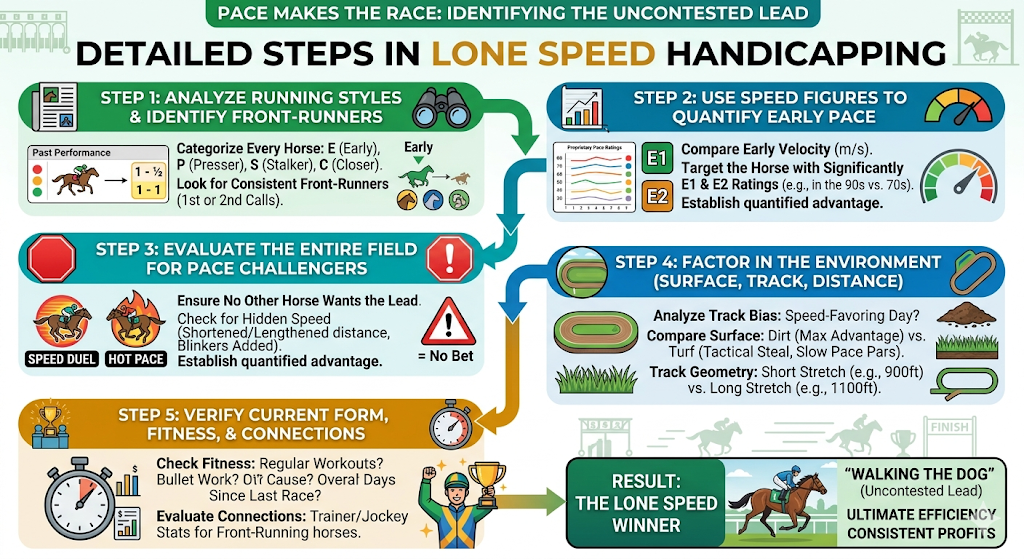
In the high-stakes world of Thoroughbred handicapping, few phrases command more respect than “pace makes the race.” While raw speed figures can indicate which horse is objectively the fastest, they often fail to predict how a race will be run. This is why professional players obsess over pace scenarios, and there is one scenario that stands above the rest for its consistency and profitability: Lone Speed.
It is easy to conceptually grasp the concept of lone speed—a horse possessing the ability to take an uncontested lead. We have all seen it happen; a horse “walks the dog” through slow early fractions, conserving energy while the rest of the field waits too long to make their move.
When the field finally reacts, the leader simply has too much left in the tank to be caught.
However, moving from conceptual understanding to consistent identification and profitable utilization of lone speed requires more than just passive observation. It easy to realize that identify and utilizing the benifit of lone speed but a defined easy to follow process is crutial to achievining this handicapping taaks.
This post will break down that critical, missing link, providing you with a step-by-step framework to transition lone speed from an occasional lucky break into a systematic advantage.
1. Analyze Running Styles to Identify Front-Runners
The first step is to categorize the running style of every horse in the race by looking at their past performances. You are looking for horses that prefer an “Early” (E) or front-running style.
Scan Running Lines: Look at the “points of call” in a horse’s past races. The first and second calls are critical for sprints (typically 2-furlong and 4-furlong marks) and route races (typically 4-furlong and 6-furlong marks).
Target “1s”: You are looking for a horse that consistently has “1” listed in these early points of call, especially if followed by a small number of “beaten lengths” (e.g., 1 - ½ or 1 - 1). This shows the horse consistently gets to the front.
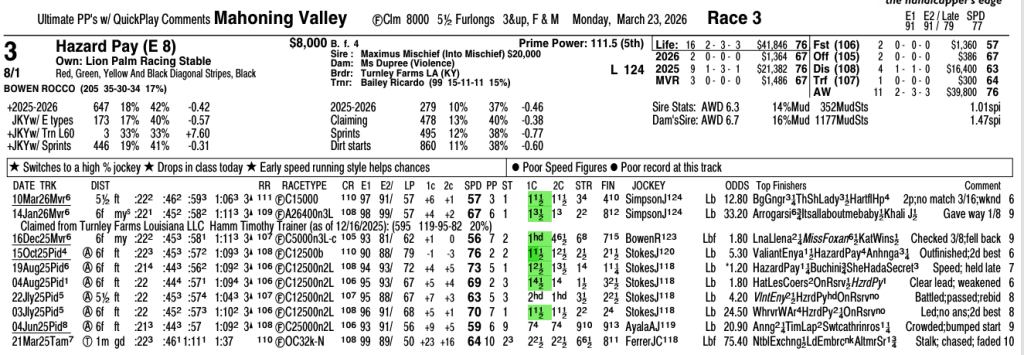
Define Stalkers vs. Closers: Categorize the remaining field to ensure they are “Pressers” (just off the lead), “Stalkers” (mid-pack), or “Closers” (late runners). If the rest of the field runs off the pace, your potential lone speed horse is confirmed.
2. Use Speed Figures to Quantify Early Pace
Once you have identified a potential front-runner, use specific speed figures to prove that they are faster than their rivals in the early stages of a race.
BRIS Pace Ratings: Many handicappers use proprietary BRIS Early Pace ratings, specifically E1 and E2.
E1: Measures speed from the start to the first point of call.
E2: Measures speed from the start to the second point of call.
Identify the Advantage: Compare the E1 and E2 ratings of all horses over their last few races. If only your chosen horse consistently runs E1/E2 ratings in a higher tier (e.g., in the 90s or 100s while the rest of the field is in the 70s or 80s), it has a quantified pace advantage and is a strong candidate for lone speed.
3. Evaluate the Entire Field for Pace Challengers
A horse is only “lone” speed if no other horse in the race wants to challenge them for the early lead. This is the critical step where a standard speed horse is differentiated from true lone speed.
Look for a “Speed Duel”: Check the past performances of every other horse again. If you find even one other horse that has an “Early” (E) style with “1s” in its running lines, a “speed duel” or “hot pace” is likely. In this scenario, the two speed horses will likely exhaust each other, favoring a stalker or closer.
Identify “Hidden” Speed: Be aware of horses that might exhibit speed they haven’t shown recently.
The “Stretch-Out”: A horse shortening from a longer “route” race to a “sprint” might show more early speed because the pace is generally slower in longer races. Conversely, a standard “sprinter” stretching out to a longer distance might easily inherit the lone lead against horses used to a more measured pace.
Equipment Changes: A trainer adding blinkers can often signify an intent to have the horse run more aggressively and closer to the lead.
4. Factor in the Environment (Surface, Track, and Distance)
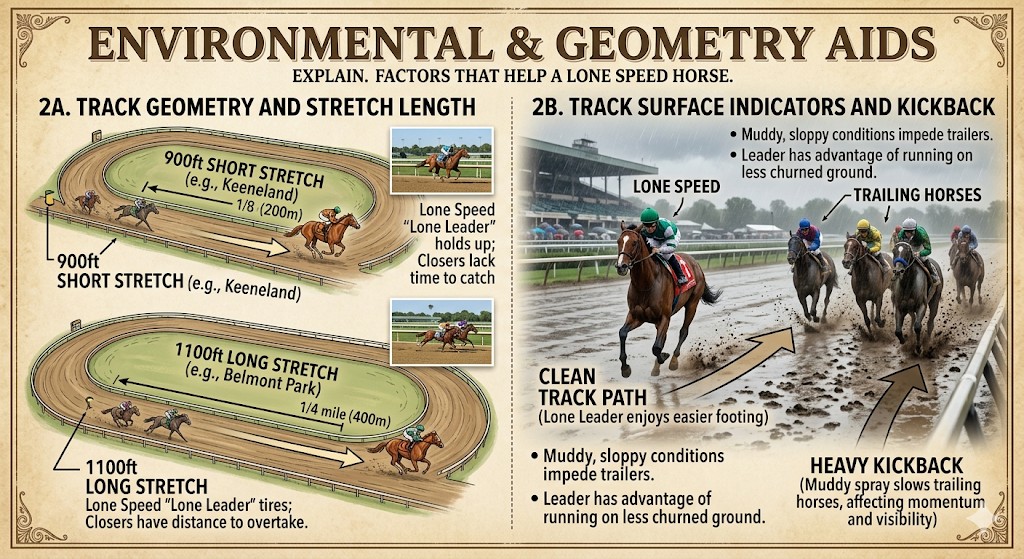
Lone speed is highly dependent on the racetrack’s geometry and composition on a given day.
Track Bias: Analyze if the track is favoring a specific running style. A “speed-favoring” track is ideal for lone speed. Look at the day’s previous results to see if horses on the lead are winning consistently.
Surface: Dirt surfaces generally favor early speed more than turf. While lone speed is extremely dangerous on any surface, a lone front-runner on turf can sometimes “steal” a race by setting a exceptionally slow pace, conserving energy while the rest of the field waits too long to make their move.
Distance: Lone speed can be effective at any distance, but it can be particularly potent in longer route races where other jockeys might allow a loose leader to “walk the dog” with a relaxed lead.
5. Verify Current Form, Fitness, and Connections
Finally, ensure the horse is physically ready to execute its front-running strategy.
Recent Workouts: Check the workout lines at the bottom of the program. Regular, recent workouts (indicated by a sequence of dates close together) suggest the horse is fit. A “bullet” workout (the fastest time of the day at that distance) can indicate a horse in peak form.
Days Since Last Race: A horse coming off a long “layoff” (e.g., 90+ days) might not have the stamina to maintain its speed to the wire, even if it takes an easy lead.
Connections: Look at the statistics for the trainer and jockey. Some trainers excel at having horses ready to win “gate-to-wire,” and some jockeys are particularly skilled at judging pace from the front end.
By systematically following these five steps, a handicapper can move beyond just finding the fastest horse to identifying a specific race dynamic where a solitary front-runner has a unique tactical edge, often at advantageous odds.
The Future of Lone Speed Handicapping
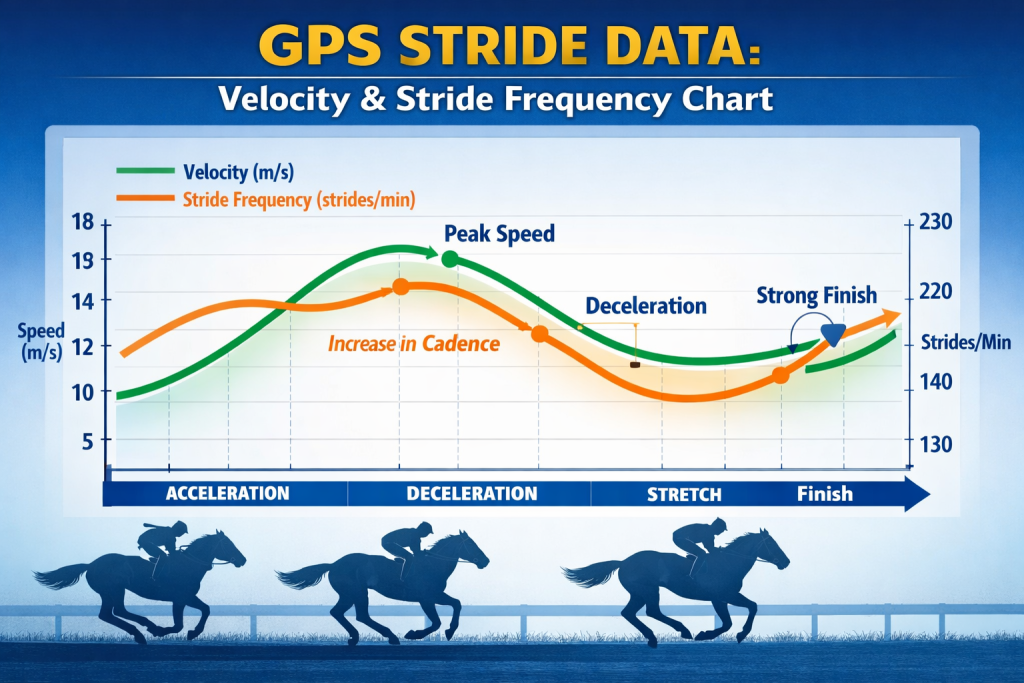
The advent of AI and GPS technology is shifting lone speed handicapping from a discipline of historical snapshots to one of real-time biological efficiency. While traditional handicapping relies on static “points of call” recorded in past performances, the future lies in the continuous stream of data captured every half-second by GPS sensors.
From Position to Precision
The “old style” of handicapping identifies a horse’s position (e.g., being 1st by a head), but AI-driven GPS data identifies the mechanical effort required to achieve that position.
Raw Velocity (m/s): AI models can now verify “Alpha Clearance” by tracking exact meters-per-second in the opening furlong, proving which horse has the physical power to clear the field regardless of their previous finishing positions.
Stride Efficiency: GPS sensors provide data on stride length and frequency. A winner in the future will be identified not just by being in front, but by doing so with a long, efficient stride that indicates they are “walking the dog” rather than laboring.
The Rise of “Pace Pars” and Tactical Steals
AI algorithms can now compare a horse’s real-time speed against “Pace Pars”—the optimal energy-expenditure curve for a specific track and surface.
Automated Bias Detection: AI can instantly detect if a track surface is “souped up” or heavily speed-biased, adjusting speed figures for subjective overrides more accurately than human analysts.
Predicting the “Stolen” Race: On turf, AI can identify a “tactical steal” in real-time by recognizing when a lone leader is setting an exceptionally slow tempo that mathematically prevents closers from catching up.
Identifying “Hidden” Speed
The future of finding value lies in AI’s ability to spot patterns the general public misses, such as the Sprint-to-Route Stretch-Out.
Second-Quarter Acceleration: AI can flag horses that naturally accelerate in the second quarter-mile without being urged, a key biological indicator of a horse capable of maintaining lone speed over a distance.
Pedigree Modeling: Machine learning models can analyze “speed-on-stamina” pedigrees to predict which sprinters will successfully carry their lone speed into longer route races.
Who Will Be the Winners?
The winners in this new era will be the “Hybrid Handicappers”—those who can masterfully marry traditional tactical insight with advanced data implementation.
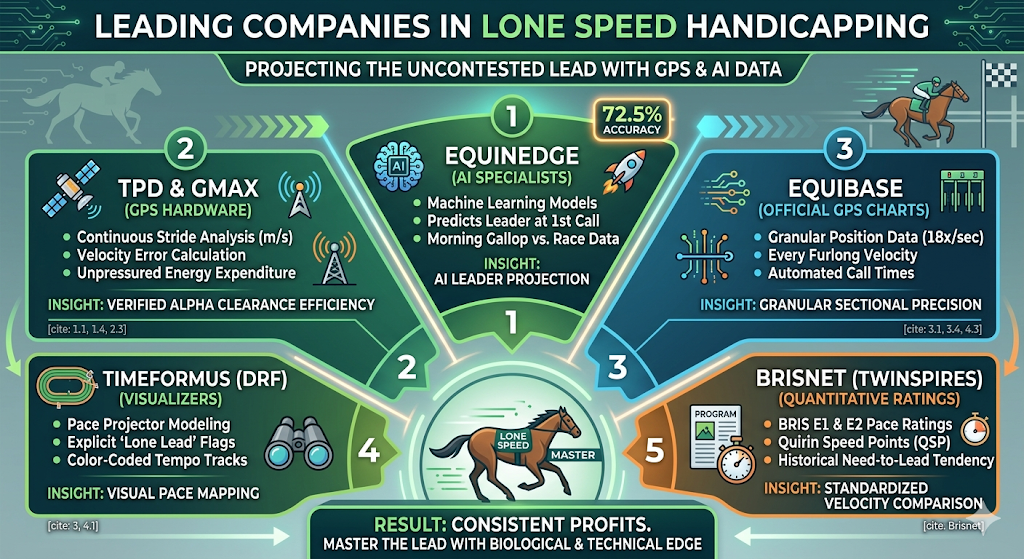
The Data-Literate Player: Success will come to those who use platforms like Brisnet for quantitative E1/E2 ratings and combine them with GPS-verified stride data.
The Value Investor: Winners will be those who use AI to create a “Fair Odds Line,” identifying “overlays” where the market has failed to account for a horse’s mechanical or environmental advantage.
The Disciplined Architect: Players who use the ABC Wagering Method to structure multi-race “Singles” around high-conviction lone speed threats will maximize their ROI while minimizing exposure to “False Speed” meltdowns.
Ultimately, the future rewards the player who recognizes that while the tools have evolved into sophisticated computer-driven models, the fundamental truth remains: pace makes the race.
Leading Compaines In Lone Speed Handicapping
By systematically following these five steps, a handicapper can move beyond just finding the fastest horse to identifying a specific race dynamic where a solitary front-runner has a unique tactical edge, often at advantageous odds.
Lone Speed Analysis – Lingering Thoughts
While a horse may have superior pace ratings, drawing an outside post (far from the rail) forces the jockey to use significantly more energy early in the race to “clear” the field and get to the rail before the first turn
If a lone speed horse is forced to run wide through the first turn, it negates the mechanical advantage of energy conservation, as the horse travels a greater distance than its rivals
Conversely, a lone speed horse in an inside post can often “break and go,” establishing the lead with minimal effort, which maximizes its ability to “walk the dog” through the middle fractions
Dirt surfaces are already the most speed-favoring, but moisture often creates a “sealed” or “fast” surface that acts as a conveyor belt for front-runners.
In sloppy conditions, the “kickback” factor becomes even more detrimental to trailing horses, as wet mud is heavier and more obstructive to a horse’s vision and breathing than dry soil.
A lone leader on a wet track enjoys the cleanest path, often widening their lead simply because the chasing pack is unwilling or unable to move through the intense spray of mud
Yes, because “connections” play a vital role; some jockeys are “front-end specialists” who are particularly skilled at judging pace and knowing when to “rate” a horse.
If a lone speed horse is switched from an aggressive, “send-oriented” rider to a more passive, patient jockey, the horse may not be urged enough to secure its necessary uncontested lead.
Conversely, an aggressive rider change on a “Presser” (EP) can create unexpected pace pressure, turning your projected lone speed win into a contested speed duel.
Pace is relative to the competition; a horse that had “Alpha Clearance” against $10,000 claimers may find that $50,000 allowance horses possess much faster “natural” early speed.
When a speed horse moves up in class, they often face “Early Pressers” who are fast enough to stay glued to their flank, preventing the leader from ever entering a comfortable, rhythmic stride.
For a lone speed bet to remain high-conviction during a class rise, the horse should ideally possess a “Prime Power” or “Speed Figure” edge that matches or exceeds the new level of competition.
A “claim” involves a trainer change, which often leads to an equipment adjustment or a shift in training philosophy that can fundamentally alter how a horse is ridden.
A new trainer might decide to “take the horse back” to teach it to be a “Presser” rather than a pure front-runner, effectively removing the “Lone Speed” element you were counting on.
Always check the new trainer’s statistics regarding “first off the claim” to see if they historically maintain a horse’s established running style or prefer to experiment with new tactics
By Bob Shirilla —
Horse Racing Handicapper & Founder, Daily Racing Edge