
First-Time Blinkers: The Professional Handicapper’s Guide to the “B1” Betting Angle
Every horseplayer has seen it in the program: “Blinkers On.” In the official daily racing form, this is noted as a “B1” move. To a casual fan, it’s just a piece of equipment. To a savvy handicapper, it’s a massive “tell” from the trainer that a horse’s performance is about to change—for better or for worse.
But should you actually bet it? At Daily Racing Edge, we’ve analyzed the data and trainer philosophies of legends like Bob Baffert and D. Wayne Lukas to show you how to separate the “sucker bets” from the “live” longshots.
The Featured Image: The “B1” Visualized
Our featured image (the one you see at the top of this post) visualizes the most significant equipment change in horse racing. It captures a vibrant, high-energy scene in the paddock walking ring just moments before a race. A thoroughbred is fully equipped in full-cup blinkers.
This image illustrates why this equipment change matters. We see the horse being led by a handler while bettors analyze programs on the rail. The horse’s number (4) is clear, and the grandstand and a large digital tote board listing odds are softly blurred in the background. The focus is entirely on the restrictive blue cups, demonstrating how a trainer literally zeroes a horse in on the track ahead.
The Biology: Why a Shadow Looks Like a “Predator”
To understand why blinkers work, you have to understand the horse. Unlike humans, horses have eyes positioned laterally on their skull, providing a stunning 350° panoramic field of vision. This biological design is perfected for one thing: detecting a predator from any angle.
While that’s great for survival in the wild, it’s a nightmare on the racetrack. A flapping bird in the infield or a simple shadow across the dirt track can look like a threat, causing a horse to “prop” (stop suddenly) or weave. Blinkers don’t just “focus” a horse; they physically block out the distractions that trigger their flight instinct, encouraging them to run with courage through the wire.
Know Your Gear: Full Cup vs. French Cup
Not all blinkers are created equal. When you are watching the horses in the paddock, you must observe the “cup” size. The type of cup a trainer chooses tells you exactly how much distraction they are trying to manage.
Full Cup Blinkers
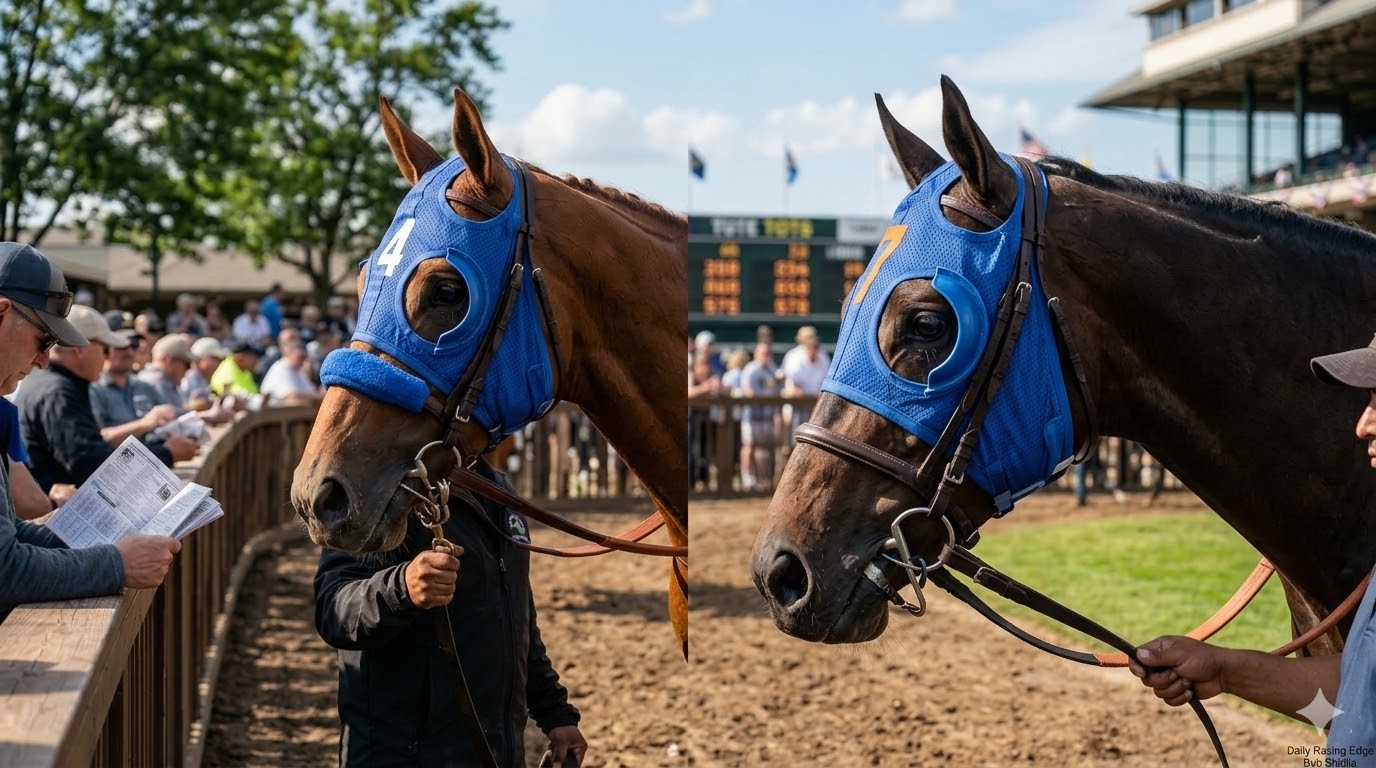
The featured horse (Number 4) above is wearing full-cup blinkers. These provide the most restriction, completely sealing off lateral and rear vision. They are designed for extremely “green” (inexperienced) horses that are easily spooked, or for competitive horses that try to “lug in” or refuse to pass rivals.
French Cup Blinkers (and “Cheaters”)
A “French Cup” (also known as a semi-cup or “cheater”) is a lighter, indented version. These have a semicircular opening (often made of clear plastic) that allows the horse to see some of its rivals. They are often used as a psychological “sharpening” tool for veteran horses who need a reminder to stay focused.
Here is a direct, side-by-side comparison of these two distinct styles, captured in the natural environment of the walking ring:
This comparison shows the total visual restriction of the full-cup blinkers (left) with the semicircular opening of the French-cup blinkers (right), which allows a “green” horse to still see its rivals.
The “B1” Betting Angles: Where the Money Is
When you see a horse wearing blinkers for the first time, don’t just look at the win percentage—look at the ROI (Return on Investment). Data suggests the most profitable “B1” moves often involve a drop in class and a change in environment.
The Maiden Drop: One of the most powerful betting angles is a “green” horse dropping from a Maiden Special Weight contest to a Maiden Claiming race while simultaneously adding blinkers. These horses are often overlooked, but the added focus helps them handle the physical and mental intensity of dirt racing, leading to large payouts at the window.
The Surface Switch: Watch for horses moving from Turf to Dirt. Dirt racing is more aggressive and involves constant flying debris. Adding blinkers for this transition is a high-percentage move because it helps the horse handle the “kickback” of dirt in their face, allowing them to remain brave through the stretch.
The “Third-Time” Rule: Many bettors overreact to a horse wearing blinkers for the first time. Data shows that the true performance spike often happens during the third run in blinkers. By then, the horse has mentally adapted to the restricted vision and is ready to fire a top performance.
Trainer Secrets: The “Baffert Move”
Sometimes, the best bet isn’t “Blinkers On”—it’s Blinkers Off.
Elite trainers like Bob Baffert and D. Wayne Lukas often use blinkers intuitively as “training wheels” based on the horse’s mental maturity. A legendary Baffert angle is removing blinkers for a horse’s second career start or immediately after a winning debut. Over a recent five-year period, Baffert has maintained an elite 75% win rate with this “Blinkers Off” move.
The logic? He uses blinkers to get them focused enough to use their natural speed and win early. He then removes them once the horse is mature enough to relax, “rate” (conserve energy), and handle the classic, longer racing distances.
The “B1” FAQ: Quick Answers for the Track
Does a horse always run faster in blinkers?
No. While they improve focus, they can also make a horse over-aggressive. If a horse is “washing out” (sweating heavily) or fighting the rider in the paddock with first-time blinkers, they might be panicking, which leads to a dramatic “fade” in the stretch.
What if the horse is 30/1 with first-time blinkers?
Be cautious. A successful blinker change is almost always signaled by “live” money in the betting market. If a horse is 30/1 on the morning line and stays 30/1 at post time despite the equipment change, the “sharp” money is not convinced.
Why would a trainer take blinkers off?
Usually to help a horse relax. If a horse is moving to a longer distance (e.g., sprinting to routing), removing the blinkers helps them conserve energy for the finish.
Your B1 Betting Checklist
Next time you are looking at the program, use this 4-point “Blinker Checklist” to help you identify a winner:
- Is this a class drop? (Maiden Special to Maiden Claiming + Blinkers = 🔥)
- Is it the 2nd or 3rd start in gear? (The “Adaptation” factor)
- Who is the trainer? (Do they have a high success rate/ROI with this specific move?)
- Is the horse moving to Dirt? (Blinkers help with “kickback” courage)
Want to see which horses are sporting the “B1” angle at the tracks today? Stay tuned to our daily picks right here at Daily Racing Edge.