
Longshot 3/11/2026 Mahoning Valley
Longshot 3/11/2026 Mahoning Valley
Race 6 | #1 Major Tom (M/L 5-1)
At 5-1, #1 Major Tom offers legitimate upset value in a race where the favorite is only slightly faster on paper. His recent Beyer pattern (70-61-62) keeps him competitive with the top runners, and drawing the rail could allow him to save ground and secure the perfect stalking trip. If the early speed horses soften each other up, Major Tom could get first run turning for home and prove difficult to catch in the stretch.
Bet — #1 Major Tom
Win: If 5-1 or higher
Exacta: 1 over 2,4
Picking Longshot Podcast
More Detail Below — Full Analysis
Why #1 Major Tom Can Win
Speed Figures Fit the Field
Major Tom’s 70 Beyer speed figure puts him right alongside the main contenders. With the favorites only running 71–73 Beyer range, the difference between them and Major Tom is minimal, meaning even a small improvement could put him on top.
Rail Trip Advantage
Breaking from post 1, Major Tom has the opportunity to save ground throughout the race, an important advantage at Mahoning Valley’s one-mile configuration. Ground-saving trips frequently prove decisive, especially when the stretch run is short.
Favorable Pace Scenario
This race includes several runners that prefer forward positioning, including Colonel Vargo, John’s Rock, and Thunderian. If those horses apply pressure to each other early, Major Tom can sit just behind the pace and strike when the leaders begin to tire.
Underrated Jockey Angle
Jockey L. Alberto Batista has historically produced positive ROI rides at Mahoning Valley, often winning with horses that are slightly overlooked in the betting. That type of rider profile often aligns with mid-priced upset winners.
Fresh Horse Factor
Major Tom enters this race off a short layoff, which can be a positive at this level. Fresh horses often show improved energy and finishing ability, especially against rivals that have been running frequently.
Final Take
While Colonel Vargo is the logical favorite, he does not appear overwhelmingly faster than the rest of the field. With competitive speed figures, a ground-saving rail trip, and the potential for a favorable pace setup, #1 Major Tom has the profile of a live mid-price contender capable of upsetting the favorite if the race unfolds in his favor.
Free Longshot Picks Daily
The Sharp Handicapper’s Playbook: Turning Angles into Profits
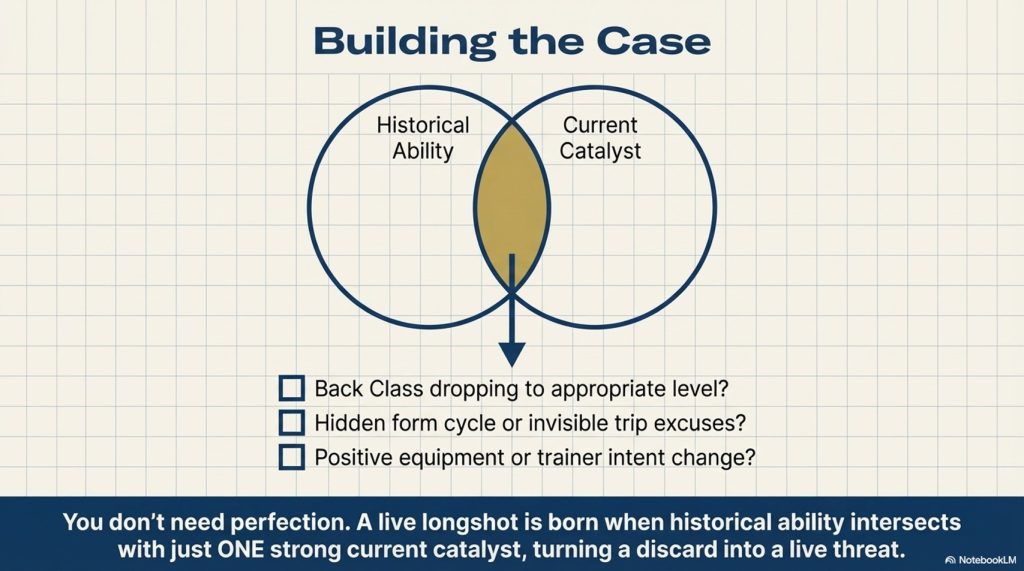
Welcome to The Sharp Handicapper’s Playbook. This isn’t your typical handicapping guide filled with complex statistics and impossible jargon. This is a collection of actionable strategies—we call them “angles”—and frameworks designed for regular horseplayers. Our goal? To help you move from casual betting to thinking and wagering like a professional “sharp.”
We aren’t going to turn handicapping into rocket science. Instead, we are going to focus on the key components of professional wagering:
Spotting Value Indicators: Knowing when a horse is ready to wake up (Angles).
Strategic Execution: Knowing how to construct the best wager based on that specific horse (Strategies).
Discipline: Managing your money so you can stay in the game (Bankroll).
This series will walk you through these phases. Grab a pen, and let’s get started.
Spotting the Signals (The Analysis Phase)
The hardest part of handicapping is identifying which horses are ready to perform. A professional doesn’t just look at who ran fastest last time; they look for hidden clues that suggest a horse is about to dramatically improve. We are hunting for “Trainer Intent.”
Angles in the “Morning Tab”
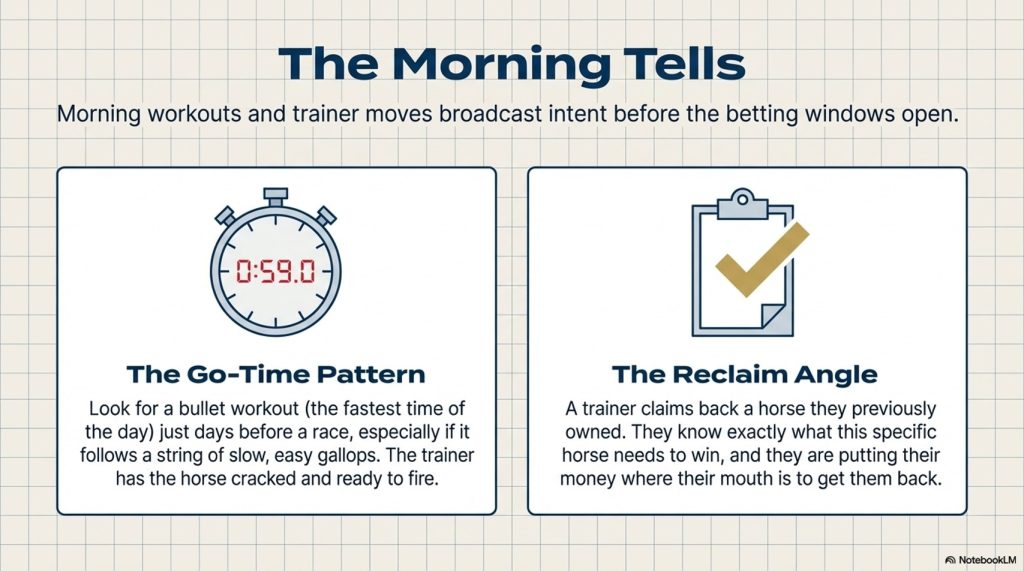
A trainer’s actions often scream their intentions, but you have to know where to look. Before the Daily Racing Form is printed, the critical data is in the “Morning Tab” (the work tab). This is the training log.
We look for two specific signals: Go-Time Workouts and Specific Intent Signals. For example, has a trainer added special blinkers for a workout? That’s a signal they are expecting a sharp performance. The image below breaks down these highly profitable entry-level angles.
Catalysts for Major Improvement
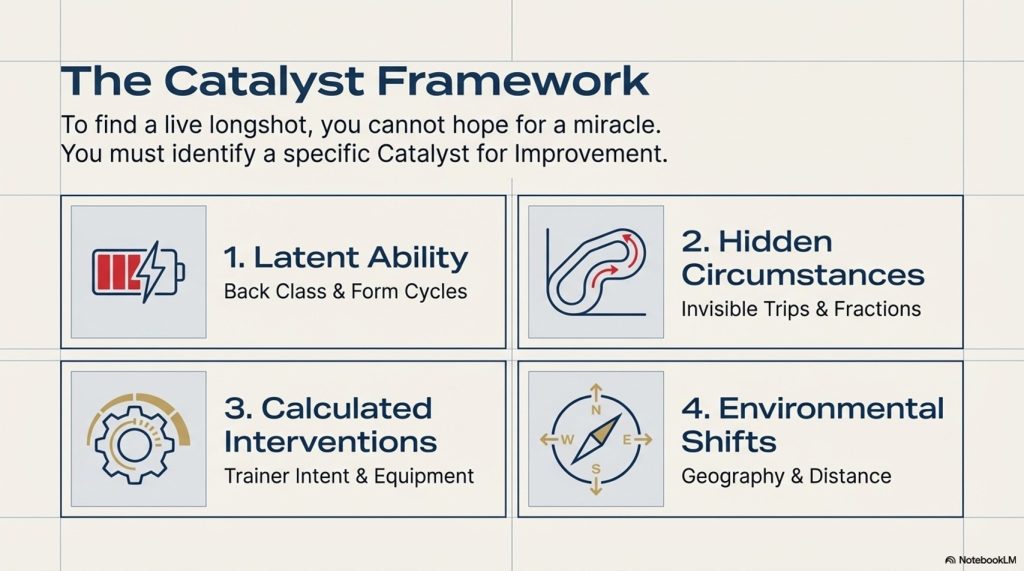
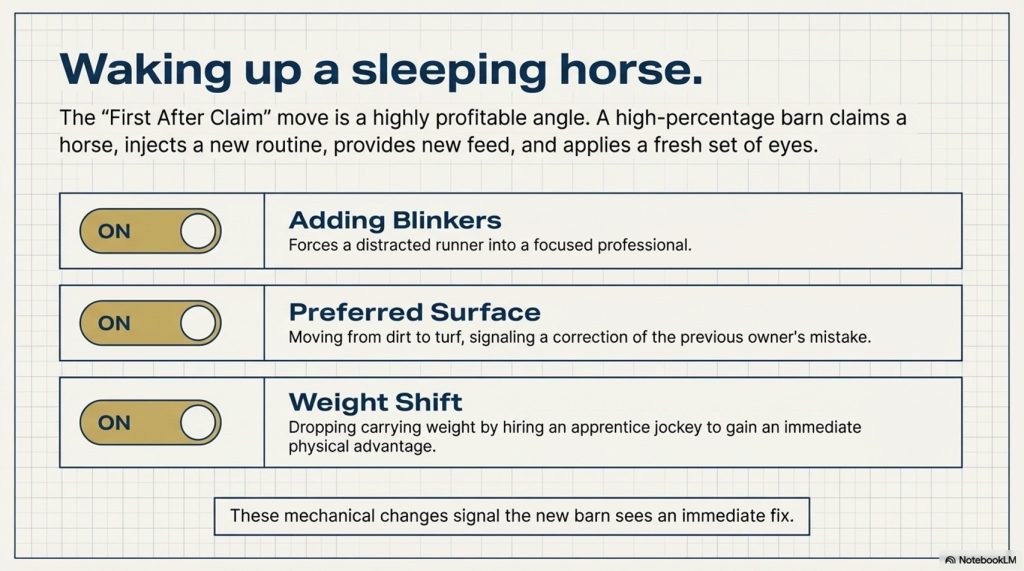
If a horse has been running dull, non-threatening races, most casual bettors (the public) ignore them. That’s exactly where we find value. Horses don’t improve by magic; they improve because something changed.
A sharp handicapper anticipates that improvement. In this framework, we look for four “Catalysts”: Equipment adjustments (adding or removing blinkers), a horse running for a new trainer (“First After Claim”), a horse returning to its favorite surface, or getting weight relief. If you see two of these catalysts coinciding, get ready to cash a ticket.
Thriving in the Chaos: Betting Low-Profile Turf Sprints
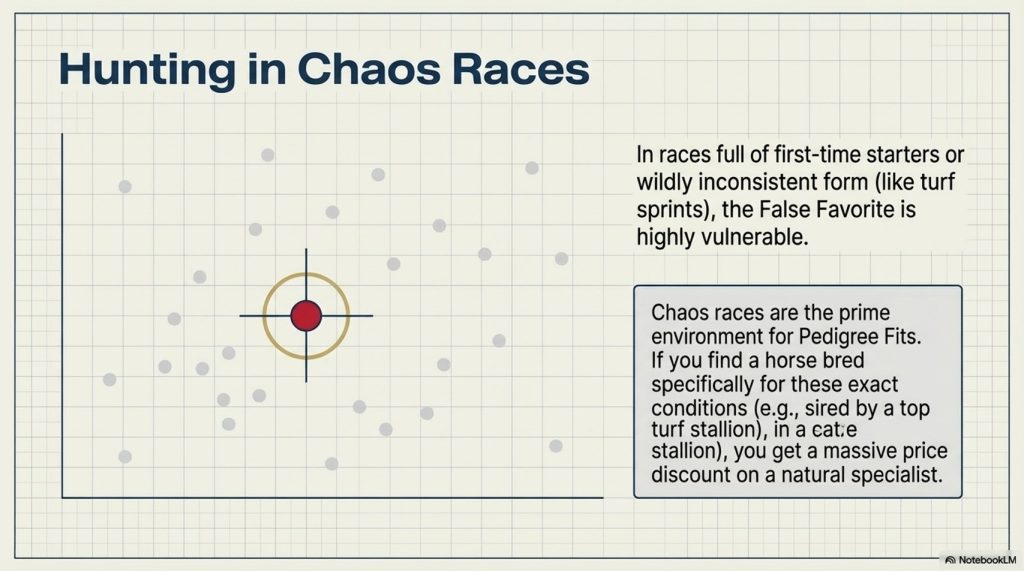
Sometimes the most intimidating races—like large fields of low-level turf sprinters with seemingly no form—are the most profitable. The public panics and bets the weak favorite. We embrace the “chaos.”
This profile helps us identify live longshots that the general public ignores. We ignore overall “speed” and focus on specific situational components: does the Pedigree suggest they will love the turf? Did the horse have strong Internal Fractions (early speed) against a faster field last time? Does this horse benefit from Situational Relief (dropping in class against weaker competition)?
Special Angles: Shipper Horses and Distance Change
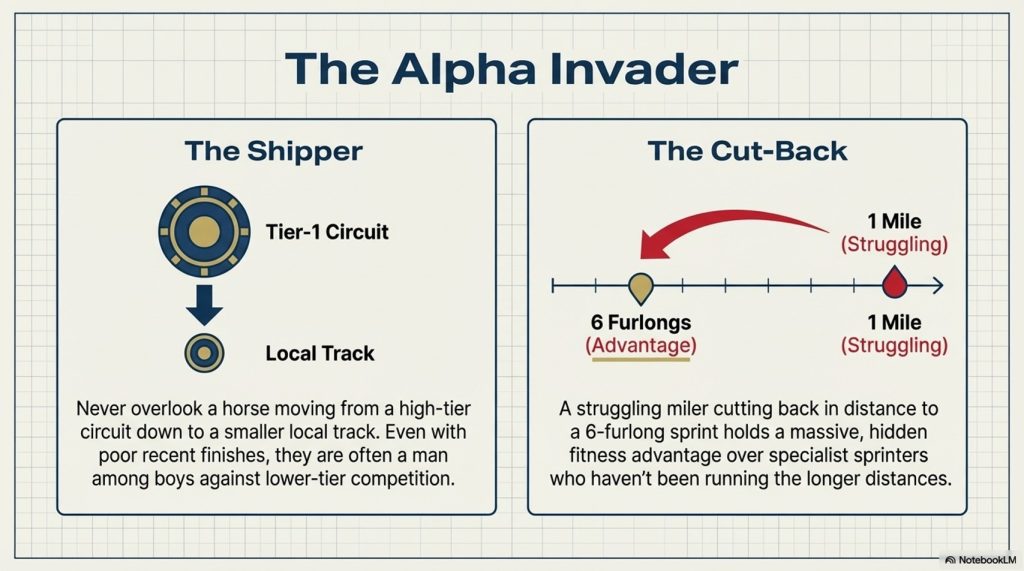
There are powerful “Macro Angles” that go beyond a single performance. The two most common are The Shipper and The Cut-Back. These are highly profitable if you catch them.
- The Shipper: Think about it: a top horse running at Santa Anita (Tier 1 track) ships across the country to run at a smaller track (Tier 2/3). It’s often overwhelming class versus local competition.
- The Cut-Back: A horse has been running tough in longer races (e.g., 1 mile). Suddenly, the trainer cuts them back to a 6-furlong sprint. This horse now has stamina that other sprinters lack. The graphic below lays out these exact scenarios.
The Execution Matrix (The Betting Phase)
Spotting a great horse is only half the battle. If you identify a 20-1 winner but only bet $2 on its nose, you’ve missed the opportunity. Professional betting is about leveraging your opinion.
This is where regular handicappers struggle. They ask, “Who do I bet?” The sharp handicapper asks, “If this situation is true, then how do I maximize the profit?”
The following images are “Betting Decision Matrixes.” They give you concrete rules for exactly how to structure your wager based on your conviction and the specific type of longshot you’ve found.
Execution: The Class / Intent Longshot
This matrix covers the situations where you have strong evidence that the horse is “ready” or “meant to win.” This includes horses dropping significantly in class (“The Class Drop”) or horses trained by a low-profile outfit whose recent workout tab (as seen in Image 0) suggests peak fitness (“Strong Workout Tab”).
This matrix tells you exactly when to play “Across the Board,” when to make them a key “Wheel” in your Exactas and Trifectas, and when to include them on your multi-race Pick tickets. This eliminates emotion and creates a precise attack plan.
Execution: The Pace-Dependent Longshot
The hardest bet to hit is the “Deep Closer”—a horse that sits last and relies on the horses in front (“The Speed”) burning themselves out in an early duel. This is high risk, high reward.
This matrix helps you understand when the pace is likely to “collapse.” If you see multiple speed horses entered, this is the time to leverage the Closer. The matrix helps you structure your bet: do you risk a larger win bet (Direct Wager), or do you use them with a “Vertical Spread” (Trifectas) in case they only catch second?
Execution: The “Hidden” Contender
Our favorite type of longshot. This is the horse that finished 8th last time, so the public thinks they are terrible. But a professional looks closer and sees they were checked hard, forced four wide on the turn, and lost by only 3 lengths in a messy trip.
This horse is a “Hidden Contender.” They are in good form but are ignored by casual bettors. Our matrix tells you when to capitalize. Because these horses are high-value and high-probability (unlike the risky closers), this strategy prioritizes “Direct Wagers” (making a standard Win/Place bet) to ensure you cash when they fire.
Execution: The Value Favorite
Every once in a while, a favorite is a favorite for a reason. Professionals are disciplined enough to know when not to chase a longshot. This matrix identifies “The Value Favorite.”
How do you know it’s a value favorite? They have specific performance advantages over the field, often combining the Class, Speed, and Trainer Intent signals. However, because they are a short price, betting them to Win (Direct Wager) isn’t efficient. Instead, this matrix helps you understand how to use this favorite as a reliable “Key” to unlock much bigger payouts in multi-race bets (Pick 3s/Pick 4s).
Structuring the Win (The Strategy Phase)
We’ve now covered how to find a strong contender and how to decide which bet type to use. The final phase is combining your ideas into professional, cost-efficient tickets for complex multi-race wagers (Pick 3, Pick 4, Pick 5).
Ticket Construction Framework
Casual bettors often make Pick 4 tickets that are a bloated mess: they take 4 horses in Race 1, 3 horses in Race 2, 5 horses in Race 3… soon, the ticket costs $120. When they miss, they lose everything.
A professional uses a structure. This “Ticket Construction Framework” organizes your thoughts into tiers:
TOP PICK (Key): Your absolute strongest opinion (your “A” horse). You are confident they can win. You build your main sequence around them.
VALUE HORSE: Your preferred, live longshots (your “B” horses). These are horses identified by our matrixes. If they win, you cash a big ticket.
CHAOS HORSE: These are the low-probability, messy, “I can’t believe that horse won” contenders. You include them only in small amounts (as a backup/cover) to survive a high-variance scenario.
The framework graphic below shows you exactly how to organize these groups for maximum efficiency.
Conclusion: The Sharp’s Bankroll Rules
Handicapping without money management is just organized gambling. If you have been profitable for a year but then lose your entire bankroll chasing one big bet, you are doing it wrong.
To close this series, we emphasize the five unshakeable rules that every sharp bettor lives by. Discipline is the final skill that separates the winners from the losers. You must “Demand Value” and “Adhere to Strict Bet Units.” Success isn’t about winning one big bet; it’s about surviving the losing streaks to stay profitable over months and years.
Stop betting the “obvious” horse. Look for the trouble, the intent, and the change. That’s where the value lives.
Transcript – Picking Longshot Podcast
Betting Against the Grain: Lessons from “Long Shots Daily Racing Edge”
Most horse players spend their afternoons grinding away at “chalk”—the favorites that everyone else is betting on. They stare at the racing program until their eyes bleed, trying to squeeze a tiny bit of profit out of a 2-1 horse.
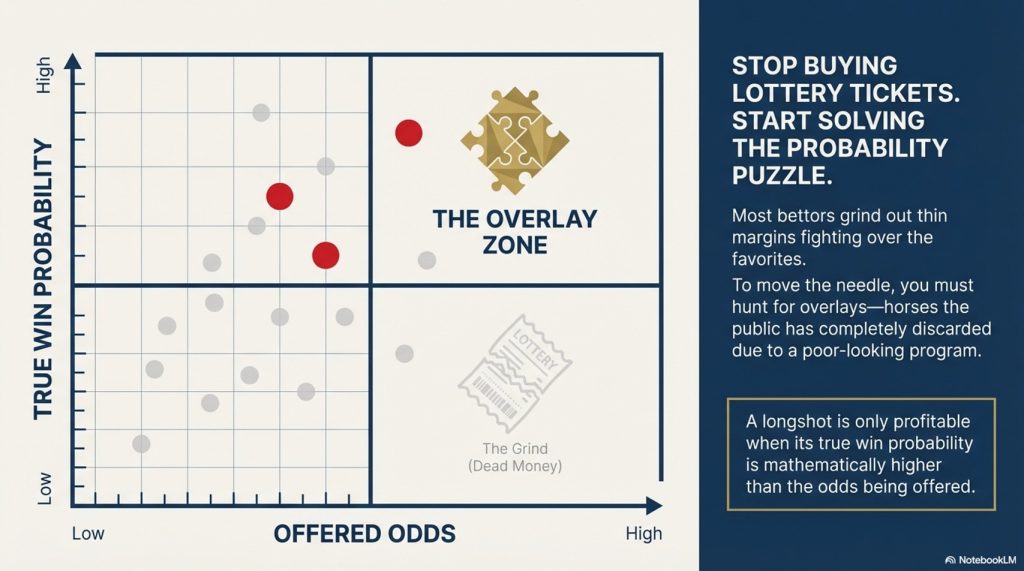
But as we discussed in our latest Deep Dive, the real professionals aren’t looking at what’s obvious. They are hunting for overlays: horses whose actual chance of winning is much higher than the odds on the tote board suggest. Drawing from the analytical insights of handicapper Bob Shirilla, let’s break down how to stop following the crowd and start finding the 20-1 gems the public has blindly discarded.
1. The Psychology of Public Blindness
The foundation of Shirilla’s strategy is behavioral economics. The betting public is generally risk-averse; they want a “safe” bet. When they see a horse with a “bad” recent running line, they toss it out immediately.
This creates Public Blindness. If a horse is 20-1, the public thinks it has a 4.7% chance of winning. But if your analysis shows that horse actually has a 15% chance, you’ve found a massive mathematical edge. You aren’t looking for a flawless horse; you are looking for a horse that looks bad for a specific, fixable reason.
2. Hunting for the “Catalyst for Improvement”
How do you distinguish a washed-up horse from a hidden gem? Shirilla points to several key triggers:
- Back Class: Look past the last two starts. A horse dropping from “Graded Stakes” to a “Mid-level Claimer” has a massive class advantage that the public often ignores due to recency bias.
- The Hidden Form Cycle: A horse might have three “dismal” finishes, but were they on a muddy track they hate? Or on turf when they are bred for dirt? These are false negatives.
- The “Go Time” Workout: Don’t just look for fast times. Look for a sequence of slow maintenance gallops followed by a “bullet” work (the fastest at that distance) just days before the race. That’s a trainer “tightening the screws.”
- The Reclaim Angle: When a trainer claims a horse back that they used to own, they are signaling they know the “secret code” to fix what the previous trainer got wrong.
3. The “Invisible Trip” and Geometry
Sometimes the data is right in front of the public, but they don’t know how to read it.
- Ground Loss: A horse that finished 6th but was parked 4-wide around every turn actually ran significantly farther than the winner. If they draw an inside post today, they are primed for a massive effort.
- Pace Pressure Relief: If a speed horse has been caught in “suicide duels” (two jockeys refusing to back down) for three races, the public assumes they have no stamina. If they are the lone speed in today’s race, they can jog uncontested to the wire.
4. Architecting the Bet: It’s Not Just About Winning
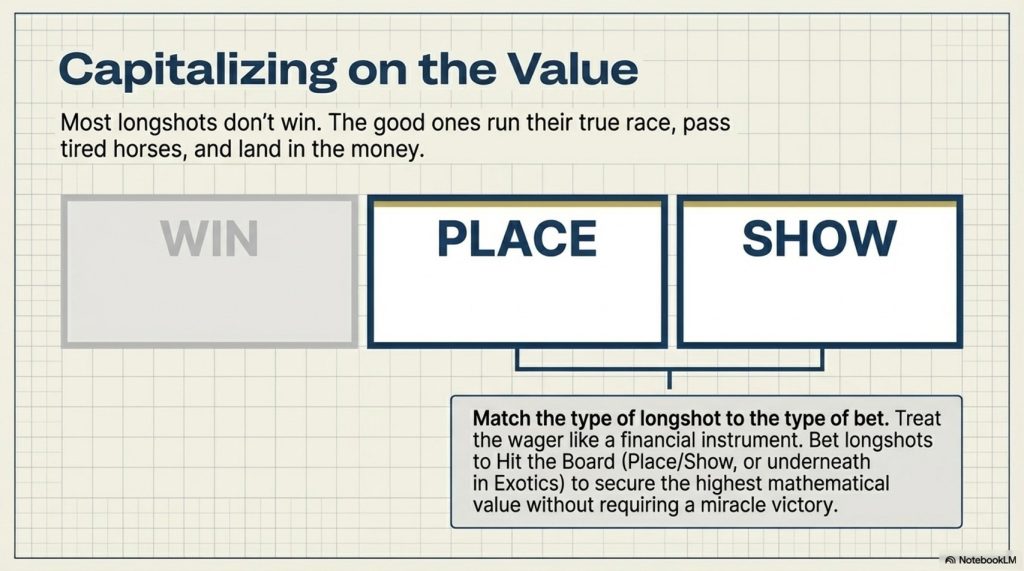
Shirilla’s most “tough-to-swallow” pill? Most long shots do not win. If you only bet them to win, you will burn your bankroll. The sustainable profit is in the “underneath” of the ticket.
| Long Shot Profile | Betting Strategy |
| Hidden Trip (The “Holy Grail”) | Bet to Win/Place; Key them on top of Exactas. |
| Pace Dependent (Deep Closers) | Bet to Show only; use in 2nd/3rd spots of Trifectas. |
| Lone Speed | Bet to Win only (it’s a “boom or bust” scenario). |
| Class/Intent (The Reclaim) | Bet Win/Place; Box in Exactas with the favorite. |
Pro Tip: Use the “Public’s Favorite” to anchor the top of your bet, but use your “Value Long Shot” to juice the bottom of the payout. A 20-1 shot finishing second can trigger a much larger payout than a 5-1 winner.
The Bottom Line
Handicapping isn’t about predicting the winner; it’s about predicting which horses will outperform their artificially inflated odds. Whether it’s an ugly racing form, an undervalued stock, or a “messy” resume, the highest value is often found where the crowd refuses to look.